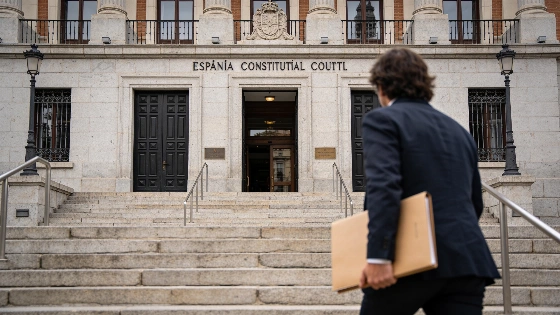
Spain’s Constitutional Court has declined to fast-track the Ombudsman’s request to restore voting rights for more than 163,000 people naturalised under the law of grandchildren. The issue now rests with the Supreme Court.
The request concerned about 163,000 people who obtained Spanish nationality under the Democratic Memory Law, known as the law of grandchildren. They are already naturalised Spanish citizens, including descendants of emigrants and people exiled during the Franco period. On 21 October, the Constitutional Court declined to admit the Ombudsman’s urgent appeal by 10 votes to two. The group represents around 0.41% of Spain’s electorate.
The ruling leaves the voting issue unresolved: the matter now rests with the Supreme Court. The Constitutional Court considered the request premature because the Supreme Court proceedings over the affected citizens’ objections had not concluded. The urgent appeal sought to restore their right to vote immediately, but the court refused. The Supreme Court’s restriction remains in place for the general election scheduled for 29 November: those affected must demonstrate that they meet the law’s requirement of descent from exiles. Once the Supreme Court issues a further decision, the Constitutional Court may reconsider whether to admit the constitutional appeal. The Ombudsman argued that barring the citizens from voting would cause irreparable harm, since they could not exercise that right retrospectively.
Javier Milei’s visit to Spain also sparked confrontations. The Argentine president called Pedro Sánchez an unacceptable dictator and described himself as a friend of Santiago Abascal. He was due to meet Isabel Díaz Ayuso at five in the afternoon. At the Universidad Rey Juan Carlos de Madrid, protesters called for him to leave and chanted anti-fascist slogans.
The PSOE welcomed Milei with an ironic banner. Sánchez explained why he identifies as left-wing and shared a song by Lali Espósito, who had responded to her confrontation with Milei. Later, the Argentine president insulted journalists in Madrid after they asked questions he disliked.
In electoral politics, the Frente Amplio ruled out an agreement with the PSOE to withdraw its Congress candidates in small provinces and maximise election results. All sectors of the coalition denied holding talks with the Socialists, despite Emilio Delgado’s claim on Tuesday night. Separately, PSOE and Frente Amplio agreed to run joint lists for the Senate on 29 November, using a single ballot. The arrangement covers 47 constituencies, mainly across 43 provinces, and includes Izquierda Unida, Movimiento Sumar and Más Madrid, as well as regional parties including Compromís, Chunta Aragonesista and Ceuta Ya. This is a Senate agreement, not an equivalent pact for Congress; Podemos and Comuns were initially outside the arrangement. A separate Senate pact report covered PP and Vox considering coordination over Senate candidates.