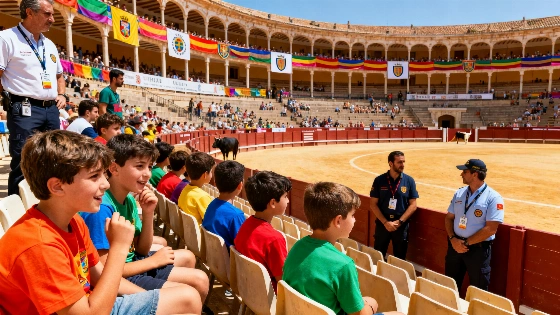
A new initiative at the Feria de San Juan de Badajoz has drawn sharp criticism from child-protection and animal-welfare organizations. For the second year in a row, the event features a dedicated box for children aged five to twelve, offering free access to bullfighting festivities. Promoted by Fusión Internacional por la Tauromaquia, the measure aims to introduce young audiences to bullfighting through educational activities and recreation during the festival.
The children's box, located in the shaded section of the Badajoz bullring, is scheduled for June 20 and 24. Organizers say qualified monitors will supervise the children throughout the event, explaining bullfighting in age-appropriate terms and organizing games between each bull's appearance. Children can attend without a parent or legal guardian, a detail that has intensified the controversy.
Fundación Franz Weber, an environmental and child-advocacy group, has publicly opposed the initiative. The organization argues that allowing children as young as five to attend bullfights, even under professional supervision, conflicts with recent recommendations from the United Nations Committee on the Rights of the Child. In its concluding observations on Spain, published on February 6, 2026, the Committee expressed concern that children continue to witness “the violence and death of participants” during bull-related festivities.
The Committee recommended that Spain, at both national and autonomous-community levels, set an age minimum of 18, without exceptions, for participation in bullfighting events. It separately called for awareness campaigns for the public, including officials and the media, about the possible negative effects of bullfighting-related violence on children, including spectators. The recommendation is directed to the Spanish authorities; it is not itself a statutory prohibition or court order. Fundación Franz Weber argues that child-protection concerns also apply to minors attending as spectators, who, it says, may witness explicit violence against animals and experience distress or traumatic effects.
Fundación Franz Weber says promotional materials display the official logos of the Ayuntamiento de Badajoz and Diputación Provincial de Badajoz. The Junta de Extremadura logo also appears, which the foundation says signals institutional support for the project. It questions whether that backing aligns with Spain's obligations under the Convention on the Rights of the Child, ratified in the 1990s. The foundation has also requested details about the specific training of staff supervising the children and says the best interests of the child must take priority in any activity targeting minors.
The dispute is part of a wider debate over how the Committee's recommendation should apply in practice. In October 2026, Fundación Franz Weber criticized a separate event in Huéscar, Granada, where admission to a novillada was free for people under 18. The foundation cited the February recommendation and argued that its concerns also apply when minors attend as spectators rather than take part in bullfighting.
Safeguarding concerns have also arisen in connection with bullfighting schools. In Salamanca, Fundación Franz Weber filed objections on February 10, 2026, to an anti-harassment protocol used by the Escuela Taurina, criticizing the role of an internal “Commission for the Study of Harassment.” The foundation argued that the commission lacked a specific legal basis and could delay referring serious cases to competent authorities, including the juvenile prosecutor's office. The Procurador del Común de Castilla y León subsequently asked the Diputación de Salamanca to revise the protocol so internal procedures would not delay notification to the authorities, and to provide a reasoned response to the foundation's submissions.
Fusión Internacional por la Tauromaquia defends the children's box as a safe, educational way to connect new generations with a longstanding cultural tradition. The company says the initiative lets families enjoy the festivities knowing their children are in professional care. Organizers say the program is designed to encourage understanding of bullfighting in a way tailored to young participants.
The debate in Badajoz reflects a broader national discussion about bullfighting's place in Spanish society, particularly where minors are concerned. Bullfighting remains a protected cultural practice in many regions, while several autonomous communities have restricted children's attendance at such events. The Committee's recommendation sets an 18-year minimum for participation and separately calls for public awareness of potential effects on children, including spectators. The recommendations continue to put tradition in tension with child welfare and international standards.