A memorial mural for Francoist victims was removed from El Puerto de Santa María cemetery. The local government called it "macabre," prompting legal complaints and public outrage. The artist may seek damages.
The removal of a memorial mural dedicated to victims of Francoist repression in El Puerto de Santa María (Cádiz) has triggered a sharp political and legal backlash. On June 11, municipal workers dismantled the sculptural artwork, which had stood for nearly a decade on the cemetery wall where almost 70 people were executed during the dictatorship. The decision, ordered verbally by the town’s mayor from the Partido Popular (PP), has been condemned by local associations and opposition parties, who argue it violates Spain’s Law of Democratic Memory.
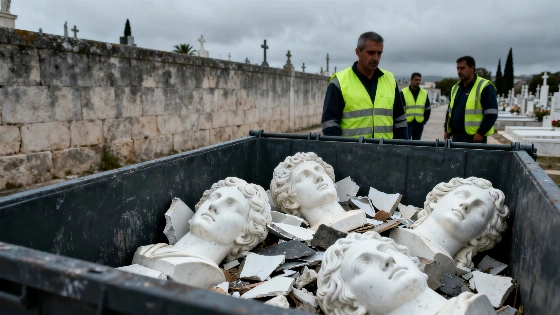
The mural, created and donated in 2016 by artist Daniel Sueiras, featured a series of white-painted sculpted faces emerging from the wall as a tribute to those executed at the site. Members of the Foro para la Memoria Histórica discovered the destroyed pieces discarded among rubbish, many of them broken. The association immediately notified the Cádiz prosecutor’s office and the State Secretariat for Democratic Memory, citing Article 62 of the 2022 law, which penalizes the destruction of memorial sites with fines ranging from €2,000 to €150,000.
The local government defended its actions by describing the artwork as “macabre faces” and “a monument to nothing,” insisting the removal was part of a general cemetery refurbishment contract. Officials claimed the wall is now “beautiful and dignified,” but their tone has drawn criticism for what many see as a lack of respect for historical memory. The artist, Daniel Sueiras, expressed feeling deeply wronged, noting he was never consulted about the removal or offered the chance to preserve his work. He is now considering legal action for material damages.
Political tensions have escalated, with Izquierda Unida and the Foro para la Memoria accusing the PP-led council of acting without proper documentation or procedure. The council, in turn, has questioned the original installation process under the previous PSOE-IU administration, though records show the mural was a voluntary donation. This dispute follows earlier controversies in El Puerto, such as the renaming of public spaces to restore Franco-era titles, moves that have repeatedly drawn criticism from memory groups.
Legal experts note that Spain’s Law of Democratic Memory was designed to protect sites and symbols commemorating victims of the dictatorship, reflecting a broader national effort to address historical injustices. The destruction of the mural in El Puerto highlights ongoing divisions over how Spain confronts its past. Similar disputes over public memory and historical symbols have surfaced elsewhere in the country, as seen in other recent incidents covered by RUSSPAIN, including public controversies involving historical commemoration.
For context, the Law of Democratic Memory came into force in 2022, aiming to ensure recognition and reparation for victims of the Civil War and dictatorship. It prohibits the destruction or alteration of memorials and mandates the removal of Francoist symbols from public spaces. The ongoing case in El Puerto may set a precedent for how local authorities interpret and apply these national regulations, especially as debates over Spain’s historical memory remain highly charged in many regions.