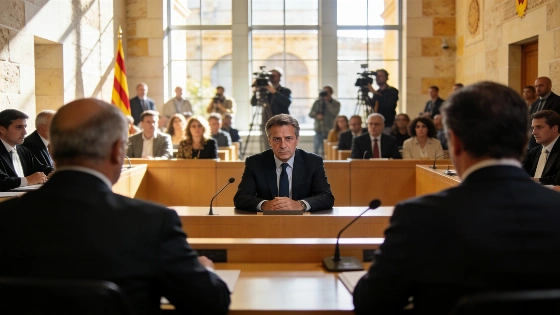
Former ICS Head Pleads Guilty to Three Crimes in Innova Case in Reus. The trial in the Innova case over embezzlement during the construction of a hospital in Reus has begun in Tarragona. The former ICS president has admitted guilt on three charges. Seven other defendants are involved in the case.
A high-profile court case has begun in Tarragona over the Innova affair, connected to alleged financial irregularities during the construction of the Hospital Sant Joan de Reus. The key figure—former president of Institut Català de la Salut (ICS), Josep Prat—has agreed with the charges on three counts: document falsification, abuse of office, and embezzlement. This became known on the first day of hearings, 14 years after the investigation was launched.
Previously, the prosecution had sought 10 years in prison and a 20-year ban from holding public office for Prat. Now, according to the defense, a deal with the prosecution will allow him to avoid the maximum penalty and possibly imprisonment. As part of the plea agreement, Prat refused to plead guilty to influence peddling, for which he faced an additional fine of 200,000 euros. The final terms of the agreement will be announced after the conclusion of the trial, which is expected to run until July.
Other defendants and case details
The Innova case involves seven other defendants, including the former mayor of Reus, Lluís Miquel Pérez, former director of Servei Català de la Salut Carles Manté, as well as employees of the municipal holding and contracting companies. The prosecution is seeking between seven and ten years in prison for them. Architect Jorge Basteneza, responsible for overseeing construction, has also reached a preliminary agreement with prosecutors, but the details of his admission have not yet been disclosed.
During the hearings, the defense attorneys pointed to investigative irregularities and questioned the reliability of the materials forming the basis of the charges. Particular attention was paid to the fact that many documents, in their view, were arbitrarily interpreted by the police. The trial covers events since 2007, when construction of Hospital Sant Joan de Reus began, and involves former managers and employees of Servei Català de la Salut.
Contract schemes and allegations
Investigators believe that Innova was used to sign bogus contracts with Manté and Basteneza, bypassing public procurement regulations. According to the court, Manté received 720,000 euros for work that was not corroborated by any report, and his company was created just ten days before the contract was signed. According to the prosecution, Basteneza, meanwhile, controlled and oversaw himself: his firm received money for supervising work that he himself performed as a contractor. Of the 40 invoices he issued, only four were backed by actual reports, and site visits were often not documented by official records.
Among the accused are also former Innova secretary Natalia Torrell, financial director Esther Ventura, construction director José Vicente Gómez, and contractor representative Sergi Luqui. They are charged with abuse of office, embezzlement, and forgery of documents. The court investigation notes that the key decisions were made by Prat and Pérez, who held executive positions in the holding and initiated the contentious contracts.
Context and parallels
The Innova case has become one of the longest-running investigations in the region. Previously, the Tribunal de Cuentas had already obliged Prat to return 900,000 euros to the municipality of Reus for unlawful payments to the Manté company. Similar cases of misconduct in government agencies regularly become the subject of court proceedings in Spain. For example, a Madrid court recently sentenced former commissioner Villarejo for the illegal transfer of data, which also sparked widespread public outcry (details on the Villarejo case).