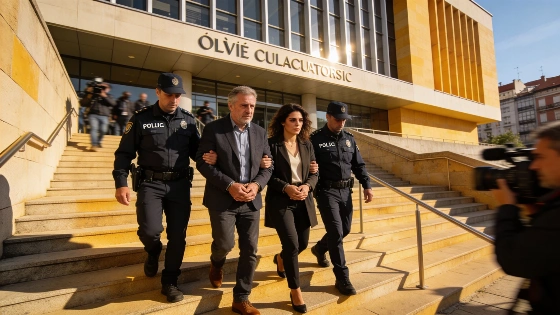
A Badajoz court has sentenced David Sánchez, brother of Spain’s Prime Minister, to nine years of disqualification from public office. The verdict prioritizes police findings over witness statements. Eleven people face similar penalties.
The Provincial Court of Badajoz has handed down a nine-year ban from public office to David Sánchez, brother of the Prime Minister, after finding him guilty of prevarication in the controversial creation of a senior position at the Diputación de Badajoz. The ruling, which also affects former PSOE Extremadura leader Miguel Ángel Gallardo and nine others, underscores the court’s decision to give decisive weight to police investigations over the testimonies of dozens of witnesses.
Central to the verdict were reports from the Unidad Central Operativa (UCO) of the Guardia Civil, which detailed irregularities in the establishment of a high-level post that ultimately went to David Sánchez. The court described the testimony of UCO’s anti-corruption chief, Lieutenant Colonel Antonio Balas, and his colleague as “especially relevant” and “highly illustrative.” Both officers firmly defended their findings, asserting that the creation of the position was a political decision originating from the presidency of the Diputación, directly implicating Gallardo. The judges adopted this conclusion, stating it was implausible that Gallardo was unaware the role was intended for Sánchez or that he did not participate directly in the process.
The court’s reasoning leaned heavily on the chronology and evidence presented by the UCO, including thousands of emails seized from Diputación staff accounts. One key piece was an email sent between conservatory directors on the day the job criteria were approved, with the subject “hermanísimo”—a reference to the Prime Minister’s brother. Although the sender later downplayed the message as a rumor, the court cited it as further indication that the appointment was widely anticipated within the institution. The ruling notes that weeks before the official selection, many within the Diputación and its conservatories were already referring to the position as destined for David Sánchez.
In contrast, the court cast doubt on the credibility of around thirty witnesses, many of whom held senior roles within the Diputación’s tightly structured and politically influenced hierarchy. The judges argued that these testimonies lacked spontaneity and reliability, often coming from individuals who were either subordinate to the accused or had recently been promoted. Specific mention was made of four witnesses who had advanced to higher positions, as well as several others closely linked to Gallardo or the accused through political or professional ties. The court concluded that such a hierarchical and politicized environment undermined the trustworthiness of their statements, a pattern also observed in the defendants’ own limited responses during the trial.
Additionally, the court dismissed the relevance of four other witnesses, including a candidate for the contested post and several current or former Diputación officials, again citing their dependence on the accused. This approach reflects a broader skepticism toward testimony from those embedded in the institution’s power structure.
The case has drawn national attention due to the involvement of the Prime Minister’s family and the implications for public sector hiring practices. The verdict follows a pattern seen in other high-profile cases, where courts have prioritized documentary and police evidence over internal testimonies. For further background on the legal proceedings and the broader context of the case, see this detailed report on the court’s decision to bar David Sánchez from office: Badajoz court’s earlier ruling on Sánchez’s disqualification.
Prevarication, as defined under Spanish law, involves knowingly issuing an unjust administrative decision. Disqualification from public office is a common penalty in such cases, preventing those convicted from holding any public position for the duration of the sentence. The case highlights ongoing scrutiny of public sector appointments in Spain, especially where political connections are involved. While the court’s reliance on police evidence over witness testimony is not unprecedented, it reinforces the challenges of establishing credibility in politically sensitive trials. The outcome may prompt further debate about transparency and oversight in regional administrations, particularly in appointments to senior roles.