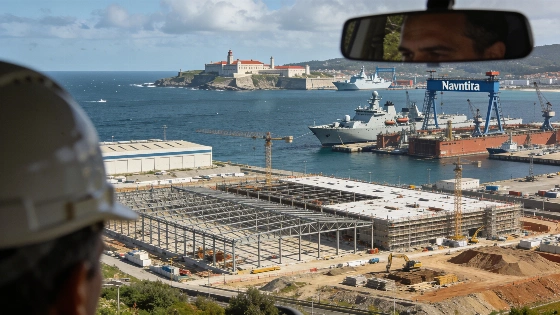
Plans for a major Chinese electric vehicle plant in Ferrol have triggered security concerns. The site is just five kilometres from Spain’s key naval base and Navantia shipyard. Authorities weigh economic gains against espionage risks.
The decision to build a large SAIC Motor electric vehicle plant in Ferrol, Galicia, has sparked a sharp debate between economic ambitions and national security. The facility, set to be the Chinese automaker’s first in Europe, will rise just five kilometres from the Ferrol naval arsenal and the Navantia shipyard—two of Spain’s most sensitive military sites. While the Galician government hails the €200 million investment as a strategic breakthrough promising 1,000 direct jobs and a production capacity of 120,000 vehicles annually, the Ministry of Defence and the CNI intelligence service have raised alarms over potential espionage threats.
Authorities in Galicia, led by President Alfonso Rueda, have fast-tracked the project, granting it “strategic industrial” status to speed up permits. The plant aims to bypass EU tariffs on Chinese vehicles by assembling cars within the bloc. Alongside the main factory at Ferrol’s outer port, plans include a logistics centre in As Pontes and a cluster of auxiliary industries in Mandiá, potentially adding 300 more jobs. The regional government has even set up a dedicated office to coordinate with local councils and streamline the process for SAIC Motor.
However, the proximity to the Ferrol arsenal—home to Spain’s five Álvaro de Bazán-class frigates and two supply ships—has unsettled defence officials. The base also houses critical missile and torpedo maintenance facilities, while the adjacent Navantia shipyard builds and modernises advanced warships equipped with the US-made Aegis combat system. The risk, according to military sources, is that the new plant could serve as a platform for monitoring naval movements or targeting sensitive technology, especially since SAIC Motor is state-owned.
Concerns are heightened by the fact that alternative sites with port access, such as Vigo and Gijón, were offered to the company but rejected in favour of Ferrol. This pattern echoes SAIC Motor’s reported plans for a plant in Tijuana, Mexico, near the US Navy’s San Diego base. Both the Spanish Navy and Navantia are now reviewing their security protocols to guard against cyberattacks and electronic surveillance. Yet, the greatest vulnerability may lie with local subcontractors—many of them small firms that supply both Navantia and, soon, SAIC Motor. Intelligence services worry that these companies could become targets for classic human intelligence operations.
Even the perception of a security breach could damage Spain’s reputation as a trusted partner for sensitive defence projects, especially with international clients and US suppliers. The US has previously expressed unease over Spain’s dealings with Chinese technology, such as the purchase of Huawei servers for judicial wiretapping systems. Now, the challenge is to reassure partners that classified military technology will remain secure, despite the new Chinese presence in Ferrol.
Political dynamics add another layer of complexity. Both President Rueda and Prime Minister Pedro Sánchez have actively courted Chinese investment, with recent visits to China to promote Galicia as a destination. Rejecting the SAIC Motor project now would be politically costly, particularly for a region hit hard by deindustrialisation and unemployment rates nearly double the provincial average. Critics argue that the plant’s initial phase will focus on assembling imported vehicle kits with high automation, limiting local job creation. Whether the promise of more components being produced in Galicia or elsewhere in Europe materialises remains to be seen.
For context, regional authorities in Spain have previously moved quickly to address controversial investments, as seen when the Madrid government listed a luxury penthouse for sale to fund wildfire recovery efforts—an episode detailed in this report on Madrid’s property decisions. The Ferrol case, however, stands out for its direct intersection of economic development and national security, with both local and central governments under pressure to balance industrial revival against the risks of foreign strategic interests.
Spain’s experience reflects a broader European dilemma: how to attract foreign investment without compromising sensitive infrastructure. As the SAIC Motor project advances, the government faces the challenge of ensuring robust safeguards while delivering on promises of economic renewal for Galicia.