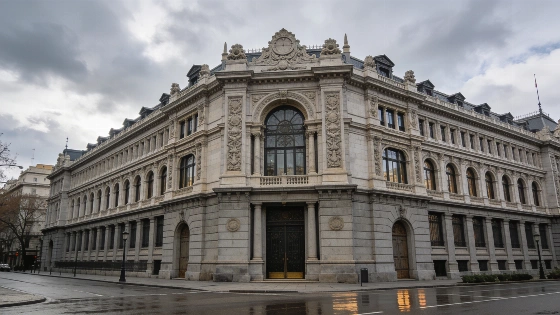
The Bank of Spain lifted its 2026 growth forecast to 2.6%, yet expects inflation to average 3.9%. Energy costs are squeezing households and public finances as the recovery gathers pace.
At Spain's MIBGAS exchange, natural-gas prices climbed from about €30 per MWh at the end of February to more than €50 per MWh in early March.
The move captures the pressure behind the Bank of Spain's latest projections. The central bank lifted its 2026 growth forecast to 2.6%, up 0.3 percentage points from its June estimate. It expects average inflation of 3.9% over the same period, leaving stronger economic activity alongside a renewed squeeze on purchasing power.
For 2027, the bank sees growth of 2.2%, which is 0.5 percentage points above its June projection. Its inflation forecast has risen to 3.7%, up 1.1 percentage points from the previous estimate.
The immediate shock is coming through energy markets. The conflict in the Middle East and the closure of the Strait of Hormuz have pushed up oil and natural-gas costs. Electricity prices are absorbing part of that increase, while services face higher operating bills. According to the Bank of Spain, the disruption affected roughly one-fifth of global liquefied natural gas trade, including Qatari supplies.
On Spain's MIBGAS exchange, natural-gas prices rose from about €30 per MWh at the end of February to more than €50 per MWh in early March after the disruption around the Strait of Hormuz.
Domestic demand is carrying the expansion. Household consumption remains the main engine as real disposable income rises and savings continue to support spending. The labour market is also described as dynamic, giving the recovery another source of momentum.
Migration-driven population growth is adding to that support. The external sector is performing well too, giving the Bank of Spain several reasons to expect activity to hold up while energy costs worsen the inflation outlook. Its October projections imply that average inflation in 2026 will be about 1.2 percentage points higher than in 2025.
The recovery is gaining speed.
The market assumptions used in the Bank of Spain's calculations pointed to fourth-quarter 2026 prices of about €141.4 per MWh for electricity and €74.2 per MWh for gas. Those futures prices indicate that energy could continue to weigh on household bills and business costs.
Those market assumptions leave little room for a quick easing. Futures used in the Bank of Spain's calculations pointed to fourth-quarter 2026 prices of about €141.4 per MWh for electricity and €74.2 per MWh for gas. That would keep pressure on household bills and business costs.
The price shock is not expected to fade quickly. The Bank of Spain ties the inflation path to the duration of the Middle East conflict and conditions around the Strait of Hormuz. Relief depends on an easing of the energy crisis and slower domestic demand. Until those conditions emerge, stronger growth will coexist with elevated prices.
Current data already shows the damage. RTÉ, citing Spanish price statistics, reported that annual inflation reached 4.9% in September, the highest level since February 2023. Since the start of the Middle East crisis, petrol prices have risen by 23% and diesel prices by 33.5%, raising costs for transport-intensive businesses and household budgets.
The mechanism is direct. More expensive energy lifts electricity bills and feeds into the wider basket of goods and services. The source material does not point to a collapse in consumption. Families are still spending because real disposable income and savings have held up, which is supporting internal demand while the Bank of Spain expects inflationary pressure to persist.
Madrid has tried to soften the increase through fiscal anti-crisis packages. Spain has ranked among the countries spending the most on that support, but the measures are also widening the public deficit. The Bank of Spain estimates that the social shield will add three tenths to the deficit of public administrations in 2026 and two tenths in 2027.
The government restored a temporary fuel-tax reduction of 20 euro cents per litre in October. The measure was approved on 29 September in response to the energy shock. The reduction is scheduled to fall to 13 cents in November and six cents in December.
Lombard Odier's analysis finds that a 75% rise in European gas prices in 2026 has had a substantially smaller effect on Spain's electricity sector than during the 2022 crisis. Expanded renewable generation and weaker links between gas and electricity prices help explain the difference, though higher bills remain a risk.
The Bank of Spain's forecast also carries a clear condition. If the conflict and disruption around the Strait of Hormuz persist, the 2.6% growth rate can coexist with a continuing decline in purchasing power.
The fuel-tax reduction is scheduled to reach six euro cents per litre in December.