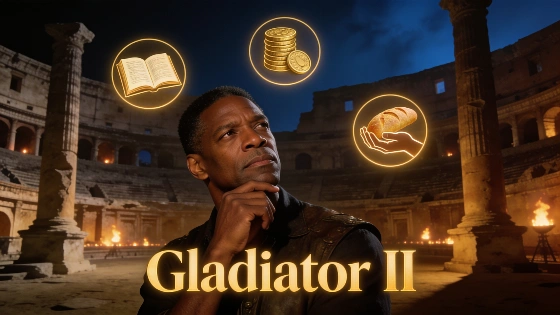
Denzel Washington, promoting Gladiator II, highlights a life philosophy built on learning, earning, and returning. His approach, rooted in personal experience, challenges the distractions of modern life and stresses the importance of giving back.
Denzel Washington, a two-time Oscar winner and one of Hollywood’s most respected actors, has again brought attention to his distinctive philosophy on the stages of life. During the recent promotional campaign for Ridley Scott’s Gladiator II, Washington revisited a concept that has become closely associated with his public persona: the division of life into three essential phases—learning, earning, and giving back. This perspective, though originally attributed to American investor Arthur Rock, has been adapted by Washington to reflect his own journey and the lessons he considers most vital.
Speaking to media, Washington emphasized the importance of focusing on personal growth in youth, building a career in adulthood, and ultimately using one’s success to benefit others. He warned of the distractions posed by social media and the digital world, urging people to disconnect and invest time in reading, reflection, and self-improvement. According to Washington, the first stage is dedicated to acquiring knowledge and skills, the second to applying them for professional and financial stability, and the third to sharing achievements through mentorship and philanthropy.
Washington’s remarks have resonated widely, especially as he continues to draw from his own experiences in films such as Cry Freedom, Glory, Malcolm X, The Hurricane, Training Day, Fences and Gladiator II. His approach stands out in an industry often focused on individual achievement, shifting the conversation toward collective responsibility and legacy. The actor’s advice, delivered with characteristic directness, has prompted many to reconsider how they structure their own lives and what they ultimately hope to contribute.
The three-stage model Washington describes is not unique to the entertainment world. It echoes a broader trend among public figures who use their platforms to advocate for social responsibility. In Spain, for example, families facing rare challenges have also turned to society for support, as seen when a Seville family mobilized resources to fund research for their son’s rare mitochondrial disease—a story detailed in this report on community-driven medical initiatives. Both cases highlight how personal success or struggle can lead to broader efforts that benefit others.
Washington’s message arrives at a time when questions of purpose and legacy are increasingly relevant, particularly as people navigate rapid technological change and shifting social expectations. His call to “be quiet, be still, learn, read, relax, grow” is a reminder that the value of each life stage lies not only in personal advancement but also in the impact one leaves behind. The actor’s philosophy, rooted in both classical thought and lived experience, continues to influence discussions about what it means to live a meaningful life in the modern era.
For context, Denzel Washington’s career spans decades and includes roles that have shaped contemporary cinema. His advocacy for giving back reflects a wider movement among high-profile individuals to use their influence for social good. The three-stage framework he promotes is increasingly cited in discussions about career planning, retirement, and philanthropy, both in Spain and internationally. As society grapples with questions of generational change and social responsibility, Washington’s perspective offers a practical, time-tested approach to balancing personal ambition with the needs of the wider community.