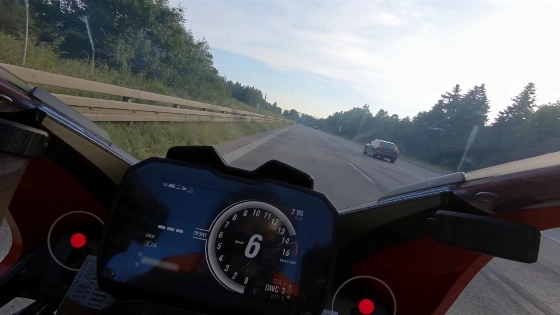
The digital speedometer of a Ducati Panigale V4 surges past 300 km/h in seconds, but the setting is what sets this viral video apart. Captured from the rider’s perspective, the footage shows the superbike weaving through ordinary traffic on a public road, overtaking cars and trucks at speeds more typical of a racetrack than a highway. The display records the motorcycle’s indicated speed; its specifications alone cannot establish the bike’s actual ground speed in the clip.
Ducati lists the current Panigale V4 with a 1,103 cc Desmosedici Stradale V4 producing 218 hp (160.4 kW) at 13,500 rpm and 120.6 Nm of torque at 11,000 rpm. Its stated wet weight, excluding fuel, is 191 kg. Those figures help explain the model’s formidable performance, but they describe the motorcycle, not a particular speedometer reading. They also do not identify the exact model year or configuration shown in the video.
The Panigale V4 first reached the market in 2018. Its development has brought changes to the engine and its intake and exhaust systems, alongside revisions to aerodynamics, the transmission, chassis and electronic controls. Published output has also varied by model year and market: Ducati lists 209 hp for a 2026 version, while its later specification gives 218 hp. The 1,103 cc road-going V4 is distinct from the Panigale V4 R, which uses a 998 cc engine and follows a different technical path.
As the numbers on the display climb, the risks of sharing the road with other motorists become stark. At 300 km/h, a motorcycle covers about 83 metres every second, before braking distance is even considered. A sudden lane change, an obstruction or a loss of control can leave other drivers little time to respond. Road conditions and visibility, as well as traffic, affect the distance needed to slow down safely.
Originally posted on X, the helmet-cam video has drawn widespread criticism, while some enthusiasts have praised the Ducati’s engineering. Many users have urged authorities to examine the footage and identify its location, then trace the rider. Depending on the jurisdiction and circumstances, extreme speeding on public roads can bring serious penalties, including large fines or loss of driving privileges, and may lead to criminal proceedings.
High-speed stunts shared online can become part of an investigation if authorities establish their origin and assess the footage. The episode echoes wider concerns about mixing high-performance vehicles with everyday traffic, a topic also explored in recent coverage of electric-vehicle infrastructure. That coverage compared London’s street-charging solutions with Spain’s slower progress (see analysis of urban mobility trends).
The Ducati Panigale V4 video has reignited debate over personal freedom on the road and the responsibility to protect other road users. A motorcycle engineered for exceptional performance does not turn a public road into a racetrack. These are shared spaces where speed leaves less room for error.