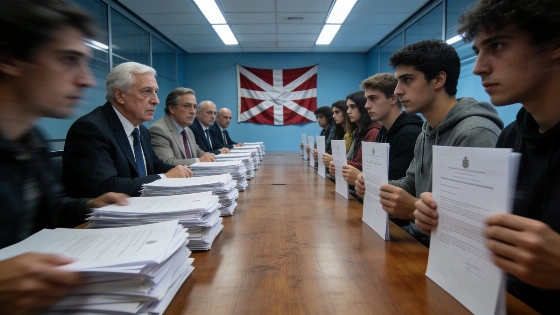
More than 12,000 EHU staff and teachers have signed a petition defending PAU exam correctors. The move follows a wave of legal challenges by students over Basque language test results and court-ordered suspensions.
A major rift has emerged at the University of the Basque Country (EHU) after over 12,000 university staff and secondary school teachers signed a petition defending the integrity of PAU exam correctors. The petition comes in response to a surge of legal appeals from students who received failing grades in this year’s Basque language exam, leading to several court-ordered suspensions of their results. The signatories argue that these legal actions represent a serious threat to the credibility of the public education system in the Basque Country.
The controversy began when a significant number of students were awarded zero marks in the Basque language section of the university entrance exam (PAU). Instead of first requesting a formal review, many students and their families turned to the media and then to the courts, challenging the professionalism of the examiners. Five separate courts have since issued precautionary suspensions of the disputed grades, a move that EHU staff describe as unprecedented and deeply concerning.
At a press conference held at the Bizkaia Aretoa, leading figures behind the petition—including Lore Erriondo, professor at the Faculty of Education, Philosophy and Anthropology, and Iñigo Urrutia, professor at the Faculty of Law and university ombudsman—read out a manifesto expressing their “concern and indignation” over the situation. The document, supported by around 2,000 university staff and thousands more secondary and high school teachers, accuses the legal challenges of undermining both the EHU and the wider Basque public education system.
The manifesto criticizes the decision to organize protests outside EHU buildings and to publicly question the work of the correctors, warning that such actions could set a dangerous precedent. It also describes the courts’ willingness to suspend grades as a “privilege” that risks eroding trust in academic procedures. The signatories say they feel abandoned by institutions, particularly the Basque government, which had previously described the families’ concerns as legitimate following the revelation that a single examiner had issued a large number of failing grades.
Despite suspicions of inconsistent grading, the manifesto insists that all established procedures were strictly followed, with every review mechanism activated to ensure fairness and equal treatment for all students. The document calls for respect for the institution and its professionals, emphasizing EHU’s commitment to transparency, professionalism, and public service. The staff also voice anxiety about the future, questioning who will be willing to serve as a PAU corrector next year given the current climate.
During the event, Lore Erriondo highlighted that the PAU, like any evaluation system, is subject to ongoing improvement, whether through changes in exam organization, teaching methods, or teacher training. However, she warned that recent confrontational attitudes could jeopardize the progress made in recent decades, particularly regarding the widespread adoption of the Basque language immersion model in schools. This model, now dominant in Euskadi, has recently come under scrutiny, with some voices—including from within the Basque language advocacy community—raising concerns about its impact on both language quality and the academic development of Spanish-speaking students.
The current dispute at EHU reflects broader tensions in Spain’s education sector, where legal challenges and public protests over exam results have become more frequent. In a related development, a recent case in Valencia saw authorities respond to public outcry over alleged fraud, highlighting the growing willingness of individuals and families to seek judicial remedies in disputes with public institutions. As the Basque exam controversy unfolds, it raises questions about the balance between students’ rights, institutional autonomy, and the stability of Spain’s public education system.
For context, the PAU (Prueba de Acceso a la Universidad) is a standardized university entrance exam required across Spain, with regional variations such as the Basque language component in Euskadi. The EHU (Universidad del País Vasco) is the main public university in the Basque Country, playing a central role in regional education policy. Disputes over exam grading are not new, but the scale of this year’s legal challenges and the resulting institutional backlash mark a significant escalation. The outcome may influence future exam protocols, the willingness of educators to participate in high-stakes assessments, and the broader debate over language policy in Basque schools.