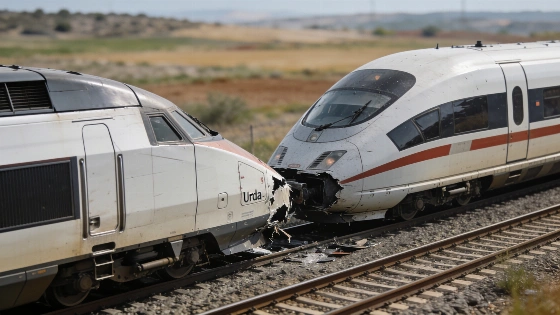
At least 68 people were killed and dozens injured when a Renfe AVE train struck an Iryo from behind shortly before 09:00 on 28 October near kilometre 118 of the Madrid-Seville high-speed line at Urda, Toledo. The trains were AVE 02080, the 08:00 Madrid Atocha-Seville service carrying 397 passengers, and Iryo 6076, the 07:54 service carrying 147. Recordings of calls between the drivers and Adif’s Madrid-Puerta de Atocha control centre have made the instructions issued before the crash a central part of the investigation.
Both passenger trains were travelling from Madrid to Seville. The Iryo was about 30 kilometres ahead of the AVE when an information-technology outage affecting the LZB train-protection system stopped trains across a reported 63-kilometre section of the line. At least six trains were brought to a stand automatically under the system’s fail-safe protocols. El Correo reported that three computers failed at about 08:30. The collision occurred roughly 140 kilometres south of Madrid.
Control told the driver of AVE 2080 to disconnect and reconnect the LZB system, then continue under the BSL backup system at normal speed. The driver asked for confirmation and received it. The AVE was authorized to resume at about 08:36 and travelled approximately 26 kilometres before the collision, according to El Correo.
The LZB continuously monitors a train’s speed and position, and can apply the brakes if safety limits are exceeded. When the system stopped operating, trains had to rely on wayside signals and direct control instructions instead of continuous automatic supervision. BSL relies on signals beside the track to maintain safe spacing between trains. The Iryo driver had separately told Atocha that a transmission fault was preventing the train from restarting.
At 08:41, the Iryo driver was also told to reconnect LZB and resume under BSL at normal speed. She acknowledged the instruction. In a later call at 08:48, she said the train still could not move; the controller told her to proceed as soon as she could.
About five minutes later, the AVE collided with the Iryo. The gap between the trains was roughly 30 kilometres, while the AVE was authorised to travel at up to 200 km/h in that area. The recordings do not establish its actual speed before impact.
The central question is why the AVE was cleared to travel at normal speed while the Iryo remained stopped. According to the account of the applicable protocol, a failure of LZB required trains to proceed at a safety speed of no more than 40 km/h, allowing the driver to see an obstacle and react. The Transport Ministry said the control centre authorized normal movement despite the more restrictive operating procedure. The supplied report says that procedure was not followed.
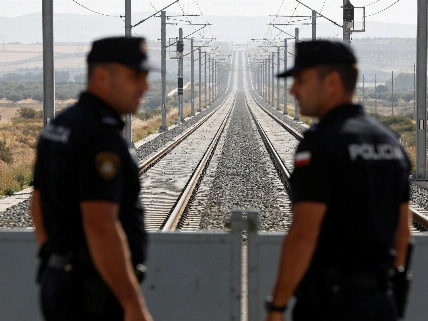
Prime Minister Pedro Sánchez ordered a full investigation. Transport Minister Óscar Puente said the decision to resume traffic rested with the control centre and described the circumstances as inexplicable. Puente characterized the preliminary cause as human error involving the authorization to resume normal movement after the protection-system failure. The Guardia Civil questioned the Adif control-room operator who authorized the AVE’s departure. Investigators are reconstructing communications between the control centre and both drivers, including reports that the Iryo could not restart. Spain’s rail-accident investigation commission is also involved, and more than 400 Guardia Civil personnel were deployed in the crash area. The inquiry has only just begun. This rail investigation is separate from the historical work at Cáceres cemetery, where an excavation found six bodies, covered in an earlier cemetery report.