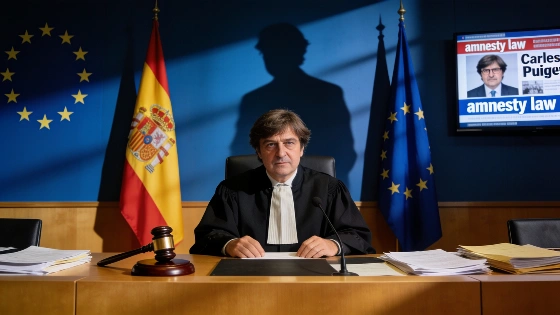
The EU's top court will decide if Spain's amnesty law clashes with EU rules. The outcome could impact over 300 people, including Carles Puigdemont. The Supreme Court's stance is under scrutiny.
The European Court of Justice (TJUE) is set to deliver a pivotal verdict this Thursday on Spain's controversial amnesty law, a measure that has already benefited more than 300 individuals linked to the Catalan independence process. The law, which came into force in June 2024, was a key condition for the support of ERC and Junts in the re-election of Pedro Sánchez. However, its application remains blocked for some of the most prominent figures, including former Catalan president Carles Puigdemont, who remains in Belgium under an active Spanish arrest warrant for alleged misuse of public funds.
The Supreme Court has so far refused to apply the amnesty to Puigdemont and others accused of malversación, arguing that the law conflicts with EU regulations. Unlike other Spanish courts, the Supreme Court did not seek guidance from the TJUE before making its decision. Now, the European court's ruling could trigger a domino effect, potentially forcing Spanish courts to revisit their stance on the amnesty, especially in cases where proceedings were paused pending the EU decision.
The TJUE will address two key questions this week. The first concerns the Tribunal de Cuentas, which is handling the financial liability of 35 former Catalan officials, including Puigdemont, Artur Mas, and Oriol Junqueras, for allegedly using public funds to support the 2017 independence referendum and related international activities. The Tribunal de Cuentas questioned whether the amnesty law's provisions on extinguishing financial responsibility are compatible with EU law, particularly regarding the protection of the Union's financial interests.
The second issue involves the Audiencia Nacional, which must decide whether to apply the amnesty to 12 members of the Committees for the Defense of the Republic (CDR), accused of terrorism-related offenses. Spanish law excludes terrorism from amnesty only if the acts meet the criteria set by a 2017 EU directive and involve intentional serious harm to life or prohibition of torture. The Audiencia Nacional has argued that the Spanish and EU definitions may not align, prompting the request for clarification from the TJUE.
Earlier, the TJUE's Advocate General issued a non-binding opinion supporting the Spanish law, stating it does not violate EU terrorism directives or financial interests. The European Commission also indicated that amnesties for terrorism offenses without fatalities or injuries do not necessarily breach EU rules. While the TJUE is not empowered to annul the Spanish law outright, it can declare specific provisions incompatible with EU law, which would require Spanish courts to adjust their application accordingly.
If the TJUE rules in favor of the amnesty, the Tribunal de Cuentas would be obliged to resume proceedings for the 35 former officials, and the Audiencia Nacional could move forward with amnesty for the CDR defendants. The Supreme Court, meanwhile, is still considering appeals related to public disorder convictions from the Girona protests after the original procés verdict. The Constitutional Court has already upheld the amnesty law in 19 rulings, rejecting challenges from the PP and regional leaders, but is awaiting the TJUE's decision before resolving appeals from key independence leaders.
For Puigdemont, the TJUE's decision will directly affect the Tribunal de Cuentas case, but its impact on his malversación charges remains uncertain. The Supreme Court maintains that the alleged diversion of public funds is not covered by the amnesty if it harmed EU financial interests or resulted in personal enrichment—criteria the court believes are met in Puigdemont's case. Even if the TJUE dismisses the EU financial interest argument, the Supreme Court could still block amnesty on the grounds of enrichment, an issue not currently before the European court.
Legal experts note that the Constitutional Court's upcoming decisions, expected in the autumn, could be decisive. The court is set to rule on appeals from Puigdemont, Junqueras, and others challenging the Supreme Court's refusal to apply the amnesty and maintain arrest warrants. Once the TJUE's verdict is delivered, the Constitutional Court will be able to proceed, and its doctrine will be binding for the Supreme Court in both convicted and pending cases.
This legal standoff highlights the complex interplay between Spanish and European judicial systems. It also echoes other recent high-profile court decisions in Spain, such as the Málaga court's ruling on artist rights, where Mijas was ordered to compensate an artist for unauthorized changes to a sculpture. Both cases underscore the growing influence of higher courts in shaping Spanish legal outcomes.
As the TJUE prepares to announce its decision, the outcome will be closely watched across Spain and the EU. The ruling could reshape the legal landscape for those involved in the Catalan independence movement and set important precedents for the relationship between national and European law. The case also illustrates the ongoing tensions between judicial authorities and political actors over the limits of amnesty and the protection of fundamental rights within the EU framework.