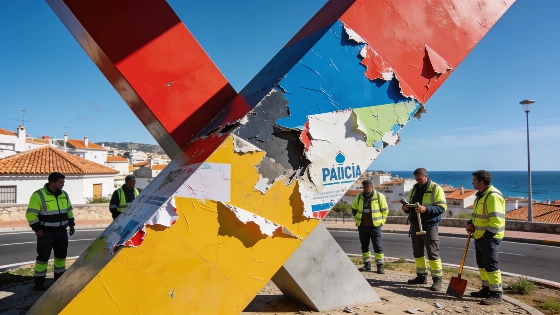
A court in Málaga has ruled that Mijas Town Hall must compensate artist Juanma Reyes after municipal workers altered his sculpture without permission. The case highlights the legal protection of artists' rights in Spain.
The Town Hall of Mijas has been ordered to pay €25,000 in damages to artist Juanma Reyes after a court found that municipal workers altered his public sculpture without his consent. The decision, handed down by the Commercial Court in Málaga, concluded that the local administration violated the artist's moral right to the integrity of his work, a principle protected under Spanish law.
The dispute began in spring 2024, when Reyes, a Málaga-born artist, discovered that municipal employees were repainting his sculpture, La Veleta, which had stood for over a decade in a roundabout near his home in La Cala. Without prior notice or consultation, workers changed the original colors and later applied vinyl coverings to the geometric installation. Reyes, surprised and concerned, contacted the Town Hall—governed by PP, Vox, and Por mi pueblo—but received no satisfactory response. He then decided to take legal action.
La Veleta was originally commissioned in 2011 by a group of 57 local business owners, following a neighborhood initiative to enhance a roundabout near two schools. Reyes was given creative freedom within a limited budget, resulting in an eight-meter-high sculpture symbolizing the construction of thought, accompanied by a mural. The work was inaugurated in October 2011 and remained unchanged until the 2024 intervention.
After noticing the unauthorized modifications, Reyes sought legal advice from Herrero&Asociados, who formally requested the restoration of the sculpture to its original state. While the Town Hall eventually removed the vinyl and repainted the sculpture in its initial colors, officials did not issue an apology or acknowledge wrongdoing. Reyes proceeded to claim moral damages, arguing that the incident reflected a broader disregard for cultural works and artists' rights.
During the November 2025 court hearing, the Town Hall defended its actions by stating the intention was to restore a deteriorated artwork, citing damage from sea salt exposure. Municipal sources told EL PAÍS that the intervention was carried out in good faith, as there was no official catalog of movable cultural assets in Mijas at the time, and the ownership of the sculpture was unclear. The court, however, found that the changes affected an essential element of the artwork—its color—and that both the public and the artist suffered from the alteration.
Judge María del Carmen Rodríguez ruled that the Town Hall had infringed the artist's moral rights, emphasizing that the colors chosen by Reyes were fundamental to the composition. The €25,000 compensation is intended to address the impact on the artist and the perception of the work by the community. Reyes described the outcome as bittersweet, noting that while the ruling affirms the importance of respecting cultural works, it is regrettable that legal action was necessary.
Reyes plans to use the remaining funds, after covering legal expenses, to support a new cultural space in Álora, La Faenera, which he is developing with his partner. The venue aims to host exhibitions, book presentations, theater, circus, and concerts, with a focus on fair compensation for artists. The opening is scheduled for summer 2027.
This case underscores the legal protections afforded to artists in Spain and the responsibilities of public administrations when managing cultural assets. It also comes at a time when judicial decisions are drawing increased attention, as seen in recent developments regarding high-profile court appointments in Spain. For example, ongoing debates about the composition of the Supreme Court and the influence of political divisions have been explored in detail in recent coverage, such as the analysis of judicial stalemates and leadership battles available here.
In Spain, the moral rights of artists are enshrined in the Intellectual Property Law, which prohibits unauthorized modifications that could harm the integrity or reputation of a work. Public art, especially in municipalities with growing populations and tourism, often becomes a focal point for debates about cultural policy, maintenance, and the balance between preservation and renewal. The Mijas case may prompt other local governments to review their procedures for managing public artworks and to establish clearer guidelines for interventions, cataloging, and artist consultation. As the cultural sector continues to evolve, such legal precedents reinforce the need for dialogue and respect between artists and institutions.