Brussels confirms Russia tried to leverage the Ceuta migrant crisis online. No evidence links Moscow to the outbreak itself. The EU steps up monitoring of digital platforms and misinformation threats.
The European Union’s External Action Service (SEAE) has acknowledged that Russia sought to capitalize on the recent migrant crisis in Ceuta by amplifying narratives on social media. However, EU officials stress there is no conclusive evidence that Moscow orchestrated the mass arrival of irregular migrants at the end of July. The distinction is crucial: while attempts to exploit the situation were detected, Brussels has not found proof that foreign state actors directly triggered the crisis through disinformation campaigns.
Following the sudden influx of tens of thousands of migrants into Ceuta, the European Commission intensified its scrutiny of online platforms. This move came after Spanish Prime Minister Pedro Sánchez publicly referenced Brussels’ reports, suggesting that both Russia and Israel had contributed to spreading falsehoods aimed at destabilizing Spain. Despite these claims, EU representatives have declined to comment on Sánchez’s statements, maintaining a cautious stance and reiterating the absence of direct evidence linking foreign actors to the initial outbreak.
Officially, the SEAE provides regular assessments of the information environment surrounding major crises or political events that impact the EU’s collective interests. According to a spokesperson, these evaluations are routinely shared with member states when their national interests are at stake. The EU recognizes that migration remains a sensitive topic across Europe, and the manipulation of related narratives on social media is not a new phenomenon. The SEAE has observed a surge in disinformation activity designed to exploit the crisis, deepen divisions, and fuel polarization.
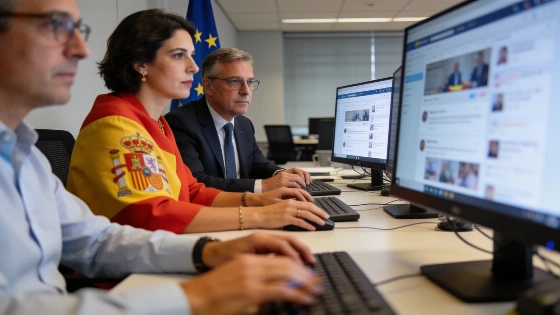
To counter these risks, the SEAE relies on a dedicated team of experts who monitor foreign information manipulation and interference (FIMI), particularly from Russia and China. Their findings are compiled in annual reports. EU sources, speaking anonymously, note that Russia’s efforts to take advantage of the Ceuta situation—regardless of whether it played a role in sparking the crisis—are unsurprising given past patterns.
In mid-August, the European Commission’s Vice President for Technological Sovereignty, Henna Virkkunen, announced the activation of a coordination mechanism with TikTok and Meta, the parent company of Facebook, Instagram, and WhatsApp. The goal: to curb the spread of false information about the Ceuta crisis and prevent further surges in irregular entries. The initiative brought together EU officials, Spanish authorities, and independent fact-checkers. However, the absence of X (formerly Twitter), which did not join the agreement, was seen as a significant gap that limited the overall effectiveness of the response.
As the EU continues to grapple with the fallout from the Ceuta crisis, the pressure on local infrastructure and services remains high. For example, Spain’s health system in Ceuta has faced unprecedented strain, as detailed in recent coverage of the region’s medical response. The ongoing challenge for Brussels is to balance rapid information sharing with member states, robust monitoring of digital platforms, and the need to protect public debate from manipulation—especially as migration remains a flashpoint for both domestic and foreign actors.
In recent years, the EU has expanded its regulatory framework to address digital disinformation, including the Digital Services Act, which sets new standards for content moderation and platform accountability. The Ceuta episode underscores the complexity of managing cross-border information threats in real time, particularly when multiple state and non-state actors are involved. As migration pressures persist along Europe’s southern borders, the risk of external interference—whether through direct action or opportunistic exploitation—remains a central concern for policymakers in Madrid and Brussels alike.