Spain’s health minister addressed Parliament after 80,000 migrants entered Ceuta. Medical staff report heavy strain, but authorities deny collapse. Emergency vaccination and solidarity measures are now underway.
Spain’s Minister of Health, Mónica García, appeared before the Health Commission in Congress this week to address the government’s response to the unprecedented arrival of 80,000 migrants in Ceuta at the end of July. The surge, which occurred over just two days, has placed extraordinary demands on the city’s health infrastructure and forced authorities to activate emergency protocols.
Healthcare professionals in Ceuta have reported a sharp increase in workload, citing difficulties in providing care to both local residents and new arrivals. Despite these concerns, García rejected claims of a “collapse” in the city’s medical facilities. She acknowledged, however, that the system is under significant strain, describing the situation as “tensioned healthcare.” During her visit to Ceuta, García also criticized attempts to link immigration with disease or crime, calling such associations both unfair and xenophobic.
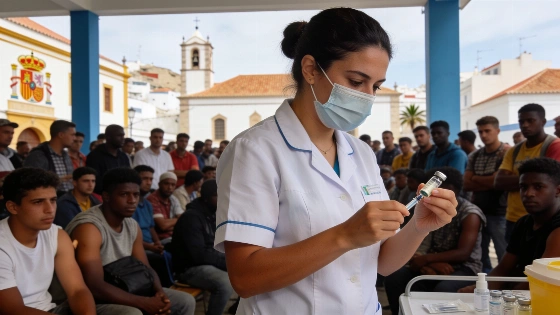
In response to the crisis, the Ministry of Health has coordinated with the Public Health Commission to launch a solidarity mechanism, ensuring the delivery of 45,000 vaccines to Ceuta. The goal is to prevent the spread of infectious diseases among migrants who have remained in the city since July. Authorities emphasized that, while the situation does not constitute a public health emergency, preventive action is essential. The ministry stressed that the most urgent priority is to guarantee dignified conditions for migrants, alongside ensuring that both locals and newcomers have access to necessary vaccinations.
The government’s approach in Ceuta comes amid broader efforts to manage the humanitarian and health challenges posed by the influx. As part of these measures, Spain recently prepared to transfer hundreds of vulnerable migrant minors from Ceuta to the mainland, aiming to provide safer shelter and address urgent health needs. Details on this initiative can be found in the report on the planned relocation of migrant girls from Ceuta.
Ceuta, a Spanish autonomous city on the North African coast, has long been a focal point for migration from Morocco. The city’s health system, managed directly by the Ministry of Health, is designed to serve a population of around 85,000 but has faced repeated challenges due to sudden increases in arrivals. The recent events have reignited debate over Spain’s capacity to respond to migration surges and the need for coordinated action between national and local authorities. While the immediate focus remains on vaccination and basic care, officials continue to monitor the situation closely, aware that further waves could again test the limits of Ceuta’s resources.