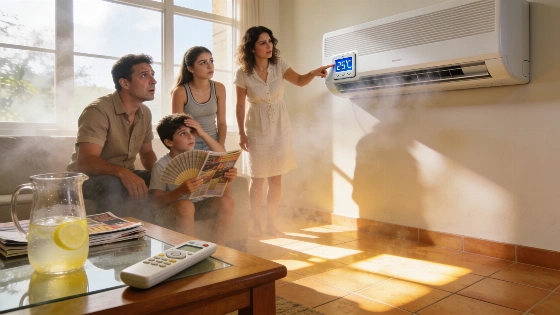
As Spain endures another intense heatwave, households are weighing whether to leave air conditioning on or switch it off when they leave home. The most efficient choice depends largely on how long the home will be empty and how quickly it gains heat. Insulation and sunlight exposure shape how outdoor temperatures affect the cooling system, whose efficiency also matters. Energy-saving guidance from Spain’s public Institute for the Diversification and Saving of Energy (IDAE) advises adapting climate-control use to occupancy and the schedules of different rooms.
There is no universal rule for every home and situation. If you plan to be away for several hours, turning off the air conditioning or substantially raising its set temperature is generally more efficient than cooling an empty house. Maintaining a cool indoor temperature consumes energy throughout the absence, while switching the unit off for only a few minutes is likely to save little. The Organización de Consumidores y Usuarios (OCU) also recommends fully disconnecting the unit to prevent standby power consumption.
For shorter absences, the balance can differ. Repeatedly switching a system off and on may require it to work harder to restore the target temperature, particularly in homes that heat up quickly. Modern inverter units, but, regulate compressor output instead of relying only on repeated full-power starts and stops. After reaching the set temperature, they can reduce power to maintain it. Steady operation can make sense during brief absences, but it does not remove the energy cost of cooling an empty home for hours. A recent analysis linked frequent cycling of air-conditioning systems in Spain to higher electricity costs; see this report on energy use and AC efficiency for a detailed breakdown.
Temperature settings are another impressive factor. Spanish energy-efficiency guidance reports that raising the set temperature by 1°C can reduce electricity consumption by nearly 10%, though actual savings vary with the equipment and operating conditions. Consumer guidance recommends around 25-26°C for overnight use; the article’s suggested range of 24-26°C is broadly in line with moderate summer settings. Lowering the thermostat does not necessarily cool a room proportionally faster. It means the system must maintain a larger difference between indoor and outdoor temperatures. One consumer-cost estimate puts eight hours of operation at about 25-26°C at approximately €0.60-€1.20 per night under the electricity prices used in its calculation, or roughly €18-€36 over 30 nights. Actual costs depend on the home, appliance, tariff and weather.
Experts recommend using ECO mode if available and keeping filters clean. The Unión de Consumidores de Extremadura advises cleaning air-conditioning filters and maintaining climate-control systems; restricted airflow can make a unit run longer. Adequate insulation and shading also reduce heat entering the home, helping limit cooling demand regardless of the thermostat setting. Because these factors differ from one property to another, identical settings do not necessarily produce identical bills.
If you are stepping out for just a few minutes, keeping the AC at a steady temperature is generally a reasonable choice. For longer absences, switching it off or raising the setpoint avoids spending energy to cool an unoccupied home; the system can be restarted upon return. Smart controls offer another way to match operation to schedules and electricity prices. Iberdrola España says its service can automatically adjust equipment use and advertises potential annual savings of €100-€300, depending on the home and technology. Those figures are company estimates, not guaranteed savings for every household. These recommendations are voluntary efficiency guidance, not a blanket legal requirement to switch off air conditioning.
Spain’s reliance on air conditioning has grown in recent years, making efficient use increasingly impressive amid energy prices and environmental concerns. Air conditioning accounts for a impressive share of household electricity consumption during summer months. Proper maintenance and moderate thermostat settings can help reduce bills, while occupancy-based schedules and improved insulation can further limit environmental impact. As heatwaves become more frequent, understanding how to manage cooling systems is increasingly critical for Spanish residents.