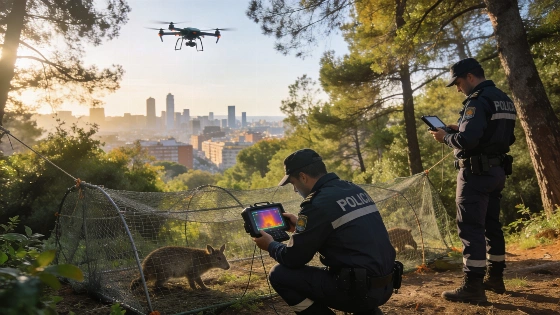
The scientific committee advising Spain's Ministry of Agriculture has sharply criticized the pace and scale of Catalonia's response to the African Swine Fever (ASF) outbreak among wild boar near Barcelona. The region is missing basic disease-control targets, raising concerns about the effectiveness of current containment efforts, information from a recent report.
Released six months after the first infected wild boar was detected on 28 November 2025, the committee's latest assessment says physical barriers and epidemiological surveillance have not been implemented with the necessary intensity. It reaches the same conclusion about carcass removal and population reduction. The report, accessed by EL PAÍS, acknowledges the impressive work already done but says the outbreak remains insufficiently contained and calls for a stronger response.
Between the initial detection and May 2026, authorities identified 325 wild boar infected with ASF across an area of 160 square kilometers. So far, the outbreak has not affected any pig farms. But, the committee says rural agents and hunters are culling a maximum of 363 wild boar per week, less than half the 800 weekly removals local authorities recommend to curb the spread effectively.
The report calls on Catalonia to strengthen physical barriers and intensify epidemiological monitoring. It also urges faster removal of wild boar carcasses and more population-control efforts. These measures are already part of the regional agriculture department's strategy, but the committee says they are not being implemented on a sufficient scale or with enough urgency. Its basic recommendation is to create a so-called “white zone,” where the wild boar population would be sharply reduced to contain the spread of the virus. The committee also recommends setting weekly carcass-removal targets for specific areas and continuously monitoring culled animals.
Another priority is improving the search for wild boar carcasses. Experts say searches near known cases are insufficient on their own; active measures are needed in at-risk areas on the outskirts of the affected zone. The committee also stresses the importance of managing local grain production in the outbreak area, or ensuring proper treatment when the grain is used as animal feed. Feed and straw should not be given to animal species susceptible to ASF infection.
The report also urges other regions of Spain to strengthen measures against African Swine Fever. Although the outbreak has so far been limited to wild boar, containing it will require a much larger reduction in their population and sustained efforts to reinforce control measures.
By 22 October 2026, Catalan authorities had analyzed 14,496 samples, recording 419 positives and 14,077 negatives. Positive wild boar were found in 13 municipalities in the Barcelona metropolitan area. The same update reported nine additional positive remains in the high-risk Collserola zone: four in Molins de Rei and two in Cerdanyola del Vallès, plus one each in Sant Cugat del Vallès, Sant Quirze del Vallès and Barcelona. Authorities estimated the animals were between one and five months old, but said none of these positives came from specimens that had died recently.
The later figures document continued surveillance and control after the committee's May assessment. By October, official notifications counted 77 outbreaks, three basic and 74 secondary. During the week preceding 22 October, 308 wild boar were captured inside the restricted area, which includes high- and low-risk zones; cumulative captures in the infected area had reached 13,684. The operation involved Agents Rurals and Mossos d’Esquadra, alongside hunting societies, the Special Group for the Prevention of Forest Fires and Tragsa hunting-control teams.
Catalonia maintained separate high- and low-risk zones around Collserola and continued carcass searches, laboratory testing and population control. The Generalitat's stated objective was to declare the outbreak eradicated before the end of 2026, provided no new positives were detected outside the areas under control. Reporting on the planned reopening of Collserola said wild-boar density had fallen below one animal per square kilometer, with public access to be restored gradually through designated “safe corridors.” Regional Minister of Agriculture, Livestock, Fisheries and Food Òscar Ordeig was associated with the staged-reopening plan.
African Swine Fever is a highly contagious viral disease that affects pigs and wild boar; no vaccine is currently available. Spain, one of Europe's leading pork producers, faces impressive economic risks if the disease spreads to commercial farms. National and European authorities are closely monitoring the outbreak in Catalonia because of its potential impact on the agricultural sector and food supply chains.