Antonio García Ferreras has criticised Madrid president Isabel Díaz Ayuso over her response to questions about the disputed Chamberí penthouse, as scrutiny grows over its purchase, intended use and failed resale.
Antonio García Ferreras made Isabel Díaz Ayuso’s confrontation with journalists the focus of the latest dispute over the penthouse. The Al Rojo Vivo presenter condemned the Madrid president’s conduct on Friday 18 September after she reprimanded reporters asking about the property’s file. Ferreras described the exchange as “alucinante” and “absolutely bizarre”.
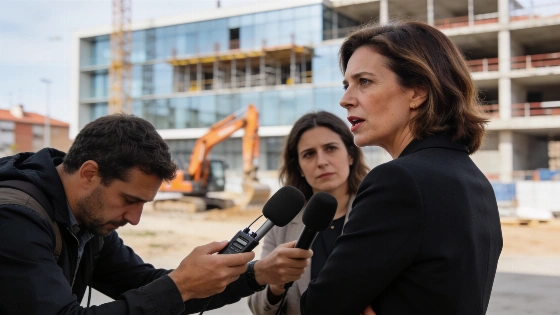
Ayuso was speaking in Alcalá de Henares at the laying of the foundation stone for a future Centro de Procesamiento de Datos (CPD). Reporters used the appearance to ask about reports concerning the property, and the exchange grew increasingly tense as the questions continued.
The first attempt to sell the penthouse received no bids. Planifica Madrid nevertheless kept the property on the market with a starting price of €6,694,201.
The president said the penthouse was unrelated to her management and insisted that it was not intended for her. She said she had visited the property only because she was looking for a possible location for her offices and wanted to see it before any decision had been made. Ayuso also complained that her initial explanations had been straightforward but had failed to convince.
Her response did not settle the issue. In Alcalá de Henares, she said she had not wanted to live in the property and did not want to know anything about the affair. Agency reports also said she called the controversy “memez” and claimed to have evidence that she had been looking for another apartment.
On Al Rojo Vivo, Ferreras challenged both the substance of the response and its tone. He noted that the controversy followed a report by El País and rejected the suggestion that the matter had not happened. He also questioned claims that the property was being sold to help fund recovery after the fires, describing that association as a populist remedy because the sale was announced after the media reports emerged.
According to El Diario, the Madrid regional government’s public explanation changed during the controversy. After initially referring to offices, the cabinet acknowledged that the property’s intended use had in fact been described as accommodation, a shift that intensified opposition demands for clarification.
Ferreras focused on the value attached to the property, cited in the discussion as 6.7 million euros, and challenged Ayuso’s attempt to redirect the conversation toward her private life. The official starting price approved by the Planifica Madrid board was €6,694,201. The sale procedure was declared unsuccessful after the deadline for offers expired on 7 September without a single bid, according to reports by RTVE and EFE carried by Infobae.
Daniel Ramírez, another contributor to the programme, made the same point from a different angle. He asked why the property had been put up for sale only after the media revealed the matter if there was nothing to conceal, and why the sale had been linked to an unquestionably moral cause such as supporting fire recovery.
The controversy emerged as political pressure was already building around other issues. The Partido Popular’s dispute over Ceuta had been taken to Brussels, as an earlier report described in a separate political context. That background does not explain the penthouse episode, but it shows how quickly a combative public appearance can become part of a wider political narrative.
The operation is also facing pressure inside the Madrid Assembly. El País reported that the Partido Popular blocked around a dozen opposition questions to Ayuso about the penthouse, while the opposition argued that the regional government had still not clearly explained why the property was bought. Government ministers and opposition figures have demanded further answers. Óscar López described the documents as an attempt to give the purchase an appearance of legality and, in separate statements, called for Ayuso’s resignation.
Ayuso has presented the criticism as a personal campaign against her. Telemadrid reported her use of the expression “mafia de Estado” and her complaint of “personal persecution”, while El Mundo quoted her arguing that Spaniards know little about the private lives of many ministers but that she is nevertheless subjected to constant scrutiny.
The reported exchange establishes a narrower point: journalists asked about a property, Ayuso responded defensively, and Ferreras made her treatment of the press the focus of his criticism. The figures and explanations discussed on air have not been replaced by a clearer account in the material provided. The editorial conclusion is therefore about the communication itself, not an alleged hidden motive. By reprimanding reporters while offering contested explanations, Ayuso shifted attention from the property to her conduct. In a story already driven by questions about an asset valued at 6.7 million euros, whose first resale attempt attracted no offers and which remains under the control or disposal of Planifica Madrid, that was a damaging choice of emphasis.