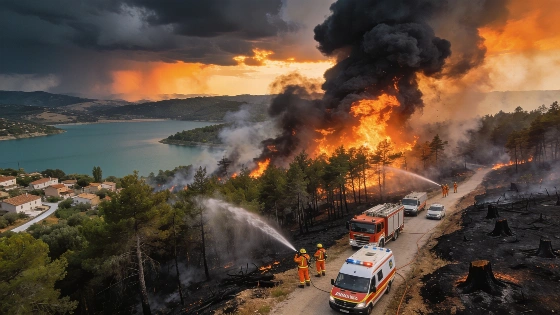
A major fire swept through makeshift shelters near the Tarajal warehouses in Ceuta. Emergency services evacuated hundreds of migrants. Authorities are investigating the cause as political tensions rise over security.
Hundreds of migrants had to leave their shelters overnight when a fire swept through an improvised camp outside the Tarajal warehouses in Ceuta. About 40 makeshift shelters were destroyed. The flames, visible from nearby neighborhoods, brought a quick response from firefighters, police, and military units, who worked to contain the fire and keep it from spreading. Spanish media and Reuters reported that the fire broke out on the night of September 11. No injuries were reported among those evacuated.
While everyone escaped safely, dozens of people lost what little shelter they had. The fire started at the front of the warehouse complex, where migrants had built a dense cluster of temporary dwellings. El País noted that families with children were among those affected. The fire spread quickly, and Ceuta’s emergency teams arrived soon after. Firefighters said they brought the blaze under control in about two hours. Police and military secured the area and blocked nearby roads for safety.
El País reports that around 200 people remained in the camp at the time of the fire, having waited for over a month for official accommodation after a mass influx from Morocco.
Authorities have started investigating how the fire began. Emergency services, cited by El Independiente and Público, said early checks point to an accidental cause, possibly a campfire or candle, but nothing is confirmed yet. The incident has renewed debate about the unsafe conditions migrants face in Ceuta and whether the city can handle ongoing arrivals. Mayor Vivas has accused the central government of hiding the scale of the problem and says insecurity in the city is now "undeniable."
The Tarajal area has long been a trouble spot for migration, with informal camps appearing as official accommodation remains scarce. The speed of the fire and the size of the evacuation show how vulnerable people are when they live outside formal support systems. Large fires in sensitive locations are not new for Spanish emergency services; as reported earlier, similar incidents have tested local response elsewhere in the country.
In early September, Spanish authorities had already prepared the temporary use of Ceuta's port area for humanitarian assistance to migrants, and regional officials announced the setup of six industrial warehouses in Tarajal as a reception center.
The immediate danger has passed, but the fire highlights ongoing failures to address why unsafe settlements exist and the lack of coordinated policy for migrant accommodation. No one was hurt, but the loss of these shelters shows how little protection many migrants have. Political arguments continue, but the basic problem remains: without real solutions, Ceuta’s most vulnerable residents will keep facing these risks, and each new crisis only adds to the city’s unresolved tensions.