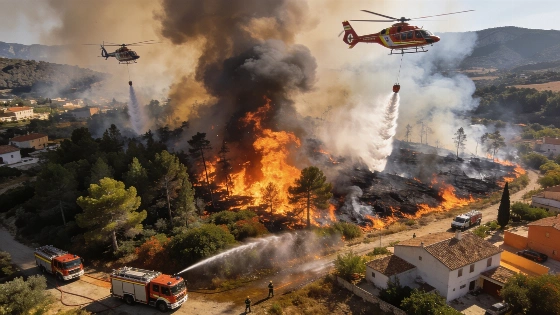
A wildfire in La Vall d’Uixò, Castellón, has forced the evacuation of a residential area. Seven aircraft and multiple ground teams are working to contain the blaze. Authorities warn the situation is deteriorating.
Emergency services in Castellón are facing a rapidly worsening wildfire that broke out on Saturday in the vegetation zones of La Vall d’Uixò. The fire, which has already spread into forested areas, prompted authorities to order the preventive evacuation of a nearby residential development. The Consorcio Provincial de Bomberos de Castellón has confirmed that the fire’s progression remains negative, with containment efforts complicated by the terrain and current conditions.
Seven aerial units—including three helicopters and two airplanes—are operating alongside extensive ground resources. On the ground, six teams from the Consorcio de Castellón and 14 forest firefighting units from the Generalitat, two of which are helitransported, are actively engaged. A heavy-duty water tanker with a 35,000-litre capacity, a command unit, three forest coordinators, a forestry technician, and a leadership team from the provincial fire service have also been deployed. Support from the Generalitat includes an ambulance, while the Castelló de la Plana fire department has sent a light vehicle, a heavy water tanker, a chief officer, and two firefighters. Local police and a Guardia Civil patrol are assisting with the evacuation and maintaining safety in the affected area.
The Centro de Coordinación de Emergencias has activated Situation 1 of the Plan Especial de Incendios Forestales (PEIF), a protocol triggered when a wildfire is expected to seriously threaten forest assets or pose a minor risk to people or non-forest property. This escalation reflects the authorities’ concern over the fire’s potential to impact both natural and residential zones. The evacuation of the urbanization is described as a precautionary measure, but officials have not ruled out further actions if the fire continues to advance.
Wildfires have become an increasingly frequent challenge in Spain’s Mediterranean regions, especially during periods of high temperatures and dry conditions. The deployment of both aerial and ground resources is standard in such emergencies, but the scale of the current response in Castellón highlights the seriousness of the situation. In recent years, similar incidents have led to significant disruptions and evacuations, as seen when a major blaze in Madrid forced thousands to leave their homes—details of which can be found in this report on the mass evacuations during Madrid’s severe wildfire crisis.
Spain’s wildfire management protocols, such as the PEIF, are designed to coordinate rapid multi-agency responses and minimize risks to both people and property. The current incident in La Vall d’Uixò underscores the ongoing vulnerability of forested and peri-urban areas to fire, particularly as climate patterns shift. Residents in affected zones are advised to follow official instructions and remain alert to updates from emergency services. The situation remains dynamic, and further measures may be implemented as authorities monitor the fire’s development.