A wildfire in Vilaller, close to Aigüestortes National Park, has burned 16 hectares. Firefighters rely on air support due to steep terrain. Authorities warn the emergency could last several days.
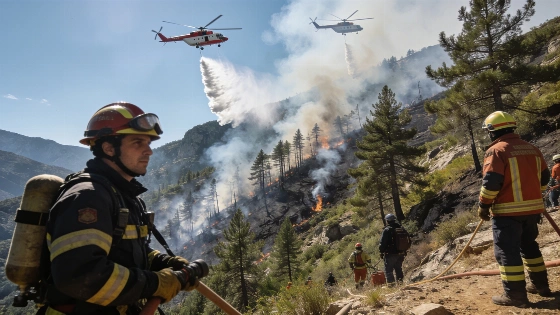
Emergency crews in Lleida province are facing a complex wildfire that broke out Friday in the high-mountain area of Vilaller, near the boundary of the Aigüestortes National Park. The fire, which has already consumed 16 hectares according to Rural Agents, is being fought primarily from the air due to the region’s steep ravines and limited ground access. Authorities expect the operation to continue for several days as challenging geography and shifting winds hamper progress.
Firefighters from the Generalitat have deployed two helicopters, two water bombers, and a cargo plane to contain the blaze, which is burning on two separate fronts. Overnight, drones were used to monitor the perimeter and assess the spread. The fire’s dual focal points have made it difficult to determine the full extent of the damage, but initial estimates put the affected area at 16 hectares, including 2.8 hectares within the protected buffer zone of Aigüestortes National Park.
On Saturday, storm-driven winds intensified the flames and triggered the formation of a pyrocumulus cloud that rose to 2,300 meters, sparking several secondary outbreaks. The suspected cause is a lightning strike recorded in the area on Friday. Today, firefighting teams are focusing on the upper section of the fire, which reached the mountain crest at 2,300 meters and now stretches across a 500-meter front. While the fire remains active, officials note that its intensity has decreased since Saturday morning, though renewed winds are expected around midday.
Five access routes to the affected zone remain closed as a precaution. Command structures have been reinforced with logistical support, a GRAF analyst, a water unit, a GRAF team, and two units from the Active Forest Prevention Teams (EPAF). The situation remains dynamic, with authorities warning that containment will require sustained aerial operations and careful monitoring of weather conditions.
This incident highlights the ongoing wildfire risk in Catalonia’s mountainous regions, where difficult terrain often limits ground intervention. In recent years, the region has faced similar emergencies, and the lack of updated wildfire response plans in many municipalities has been a concern. For example, a recent report on Catalonia’s preparedness underscored the vulnerability of rural areas to fast-moving fires, especially during periods of extreme weather.
Spain’s national parks, including Aigüestortes, are particularly sensitive to fire due to their ecological value and the difficulty of accessing remote zones. The current emergency in Vilaller serves as a reminder of the challenges faced by emergency services in protecting both natural heritage and nearby communities. As climate patterns shift and extreme weather events become more frequent, authorities continue to adapt their strategies for wildfire prevention and response in high-risk areas.