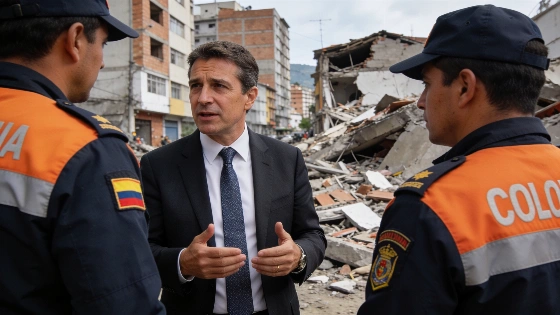
Spain’s Foreign Minister has confirmed the first Spanish victim in Colombia’s 7.4-magnitude earthquake. The number of unaccounted Spanish nationals has dropped sharply. Colombian authorities report a growing death toll and thousands injured.
Spain’s Foreign Minister, José Manuel Albares, has confirmed the first Spanish citizen killed in the powerful 7.4-magnitude earthquake that struck Colombia on Monday. The number of Spanish nationals who remain unaccounted for has fallen from 75 to 12, as efforts to locate and assist those affected continue. Colombian authorities now report 265 fatalities and nearly 3,500 injured, with the number of missing rising to 496, according to President Abelardo de la Espriella.
Among the most tragic stories emerging from Cali is that of the Saavedra Caicedo family. One of the triplets, Ana María, is hospitalized, while the bodies of her sister Sofía and their parents, Jairo and Victoria, were found by rescue teams. The search for Isabella, the third triplet, continues in the ruins of their building in the Cuarto de Legua neighborhood. Hopes of finding the entire family alive persisted for hours after Ana María was located, but were dashed by Wednesday morning, as reported by Semana magazine.
Despite the devastation, there have been moments of hope. In the same area of Cali, a young boy was rescued after surviving 32 hours trapped without food or water. His discovery was made possible by a trained rescue dog, whose alert led Red Cross teams to the child beneath the rubble. Roger Casas, head of the canine rescue team, described the operation as a collective effort by the community. Meanwhile, at the University Hospital in Cali, which suffered structural damage, families of the missing have received WhatsApp messages suggesting that some may still be alive.
President de la Espriella has declared a state of economic emergency to address the crisis, citing the country’s severe fiscal challenges. The government plans to establish a 'miracle fund' to channel national and international aid for the reconstruction of hospitals, schools, homes, roads, and airports damaged by the quake. Measures to stimulate economic recovery are also being prepared, including tax relief and support programs for businesses of all sizes affected by the disaster.
International rescue teams have joined the response. The Topos Aztecas arrived from Mexico City to assist local efforts, while the elite DART team from the United States has been supporting Colombian rescuers since Tuesday. Experts from other countries are also on the ground. David Tamayo, newly appointed director of the Unidad Nacional para la Gestión del Riesgo de Desastres (UNGRD), stated that all available resources are being deployed for risk management and emergency response. He clarified that Colombia is currently accepting search and rescue assistance only from Israel, the United States, El Salvador, and Ecuador, as these countries meet international standards for such operations.
Colombia’s Foreign Minister, Omar Bula, responded to criticism by emphasizing that no offers of help have been rejected on ideological or political grounds. He stressed that Colombia is working with all countries willing to assist, regardless of their government’s orientation. Shortly after, Israeli Prime Minister Benjamin Netanyahu announced the dispatch of an aid delegation to Colombia, following a request from President de la Espriella.
Natural disasters of this scale have a profound impact on both local communities and international relations. The rapid mobilization of rescue teams and the coordination of aid highlight the importance of global cooperation in crisis situations. For Spain, the incident underscores the vulnerability of its citizens abroad and the critical role of consular services in emergencies. Similar challenges have been faced in other regions, such as the severe storms that recently hit southern Valencia, where emergency services responded to record winds and flooding, as detailed in this report on the response to extreme weather in Alcoi and Villena. The ongoing situation in Colombia continues to evolve, with authorities urging vigilance and support for those affected.
Earthquakes of this magnitude are rare in Colombia but can cause widespread destruction, particularly in densely populated urban areas. The country’s emergency response infrastructure is being tested as it manages both immediate rescue operations and the longer-term task of rebuilding. For Spanish nationals and their families, the priority remains locating the missing and ensuring the safety of those in affected zones. The Spanish government is maintaining close contact with Colombian authorities and providing assistance where possible.