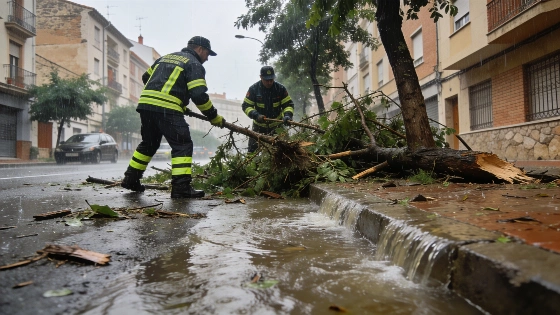
A powerful storm front swept through southern Valencia, bringing winds up to 176 km/h and intense downpours. Alcoi and Villena saw record gusts, hail, and flooding. Emergency crews handled over 160 incidents in Alicante province.
Southern areas of the Comunitat Valenciana faced a severe weather episode on Monday as a fast-moving storm front unleashed violent winds, heavy rain, and hail across multiple towns. The most extreme gusts were recorded in Villena, where Avamet measured a peak of 176 km/h, and in Alcoi, where winds reached 132 km/h at Pas del Benisaidó—setting a new local record for the past two decades. The storm, which moved from the southwest to the northeast, also brought intense rainfall, with more than 30 liters per square meter falling in just one hour in several locations.
According to the Agencia Estatal de Meteorología (Aemet), the front produced both warm and wet downbursts, causing sudden, destructive wind surges. In Pinoso, gusts hit 100 km/h, while Benilloba experienced winds up to 99 km/h and 13 l/m2 of rain. The rapid shifts in wind speed—sometimes changing by more than 60 km/h within minutes—were described as highly violent and short-lived. In Ibi, rainfall totals reached 51.2 l/m2, with other significant accumulations in Beneixama, Confrides, Xàbia, and Villena.
Emergency services were stretched as the storm battered the province of Alicante. By 20:00, authorities had responded to 163 incidents, mainly in l'Alcoià, l'Alt Vinalopó, l'Alacantí, and la Marina Baixa. Firefighters carried out around 40 interventions, dealing with fallen trees, damaged facades, torn roofs, downed cables, and fires in electrical installations. On the coast, a microburst in Calp toppled the lifeguard's chair at l’Arenal-Bol beach, while strong gusts were also reported in Xàbia, Polinyà de Xúquer, Carcaixent, and Xàtiva.
The storm's impact was especially visible in Alcoi, where streets temporarily turned into rivers. Meteorological radar tracked two main storm cells: one originating in Castilla-La Mancha, which brought large hail to areas like Alcalá de Júcar, and another forming near Pinoso. Both advanced northeast, entering Valencia province near Ontinyent and producing an exceptionally high density of lightning strikes. The risk of lightning-induced wildfires was highlighted after an afternoon blaze in Jalance required six aerial units before being extinguished. Other fires in Enguera, Montesa, Anna, and Culla were quickly brought under control, often aided by the rain itself.
While the southern half of the region bore the brunt of the storms, the north saw only isolated downpours, such as 17.8 l/m2 in Olocau del Rey. By evening, the most intense weather had moved offshore, but Aemet warned of new storm cells developing in Murcia that could again threaten the Comunitat Valenciana. The entire region remained under orange alert for heavy rain, large hail, and violent winds until after 22:00.
Looking ahead, meteorological stability is expected to return on Tuesday, with no adverse weather warnings in place. Temperatures are forecast to reach up to 34°C on the coast and 35°C inland, with nighttime lows of 25°C and 19°C respectively. The coming days should remain calm, providing a respite after the recent turbulence.
For context, Spain has faced several extreme weather events in recent years, including powerful earthquakes in neighboring countries that have tested emergency response systems. For example, a major earthquake in Colombia prompted large-scale evacuations and highlighted the importance of rapid intervention during natural disasters.
Wednesday's total solar eclipse, visible across northern Valencia, is expected to occur under clear skies, according to Aemet's latest forecast. This rare astronomical event will be watched closely, with authorities monitoring for any weather-related disruptions.
Spain's Mediterranean regions are increasingly vulnerable to sudden, intense storms, especially during the summer months. Local authorities and meteorological agencies continue to invest in early warning systems and rapid response protocols to minimize damage and ensure public safety during such extreme events.