Exhumation efforts in Jaén province yield mixed results. Nine victims found in Linares, but no trace of 173 sought in Jaén capital. Authorities adjust search strategy amid ongoing challenges.
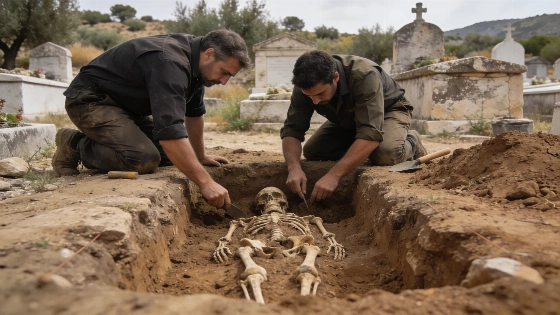
The search for victims of Francoist repression in Jaén province has produced sharply contrasting outcomes this summer. In Linares, archaeologists have recovered the first nine bodies from a municipal cemetery mass grave, while in Jaén capital, a year-long campaign ended without locating the 173 executed individuals believed to be buried there. The technical team in Jaén capital found no evidence of violent deaths among the remains, forcing a shift in strategy and highlighting the complexity of these historical investigations.
Work in Linares began in June at the cemetery’s fosa 25, with ongoing archaeological excavation, forensic anthropology, and DNA analysis. The team expects to find up to 25 victims, including prominent republican politicians such as Francisco Gil Teruel, José Piqueras Muñoz, and Antonio Moreno Pérez, as well as miners affiliated with UGT and CNT. Linares, a major mining center during the Civil War, saw many of its workers actively resist the Francoist uprising, a fact underlined by the president of the Asociación de Memoria Histórica de Jaén.
The exhumation project is funded by a €100,000 grant from the Spanish government, channeled through the Diputación de Jaén. Provincial officials stress that these efforts are not only about historical recovery but also about restoring dignity to victims and their families. The remains from Linares will be temporarily housed in a specially prepared space at the former Santa Catalina Mártir chapel in Jaén, ensuring proper conservation and identification.
In contrast, the campaign at San Eufrasio cemetery in Jaén capital, the city’s main execution and burial site after the war, concluded in July after nearly a year of fieldwork. Despite nine test pits and the excavation of 209 burial structures, none of the remains matched the profile of the 173 Francoist repression victims sought. The initial location, identified by the University of Jaén and based on historical testimony, proved inaccurate. The site revealed only secondary bone deposits and ritualized child burials, with no signs of mass executions.
Project leaders have now requested authorization to focus on broader excavation and localization, rather than immediate exhumation and identification. The high density and complex burial history of San Eufrasio, dating back to the early 19th century, complicate the search. Experts believe fosa 548 may contain leading union, political, and journalistic figures executed in the early years of the dictatorship, including Cristóbal Valenzuela, Alejandro Peris Caruana, and José López Quero. However, recent excavations uncovered only a collective deposit from the 1970s–80s, unrelated to the Civil War period.
These efforts are part of a wider initiative by the Diputación de Jaén, particularly through the Instituto de Estudios Gienenses, to recover historical memory. This includes digitizing over 15,000 judicial files of Jaén residents prosecuted during the Civil War and Francoist dictatorship. The province estimates 3,715 deaths from Francoist repression between 1936 and 1952.
Spain’s ongoing work to locate and identify Civil War victims remains a complex and sensitive process, often hindered by incomplete records and altered burial sites. The situation in Jaén reflects broader national challenges, as highlighted in other recent news, such as the government’s investment in historical and cultural projects. The search for truth and closure continues, shaped by both technical obstacles and the enduring commitment of local authorities and families.