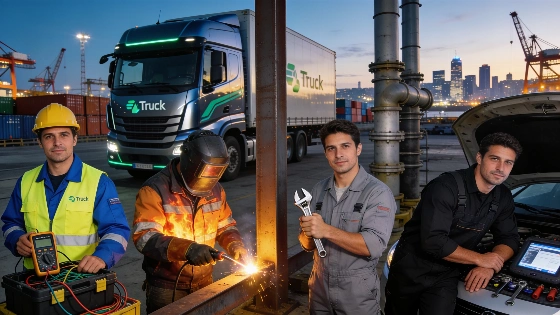
Truck drivers earning up to €6,000 a month, electricians with more work than hours in the day, and welders whose skills are in constant demand point to opportunities opening up in several skilled trades in Spain. Transport entrepreneur Mario Cozma says a persistent shortage of qualified professionals is reshaping the job market, strengthening the prospects of workers whose expertise has often been undervalued. For self-employed drivers, but, monthly invoices are not take-home pay: operating costs and taxes can substantially reduce the amount left as income.
The scale of recruitment pressure is reflected in figures from the Servicio Público de Empleo Estatal (SEPE). Its report Ajuste de la oferta y la demanda de empleo, updated in July 2026, recorded 95,340 employer-declared vacancies in the fourth quarter of 2025; 43,495 had remained unfilled for at least 90 days. Reporting on the findings identified particular hiring difficulties in construction trades, including bricklayers, electricians, and plumbers. These persistent vacancies help explain why employers compete for skilled workers and why qualified candidates can gain bargaining power.
Technical Skills in High Demand
Electricians and plumbers are sought after for building renovations, maintenance, and new infrastructure projects. The shift to renewable energy and the modernization of electrical systems add to demand for electricians, while homes and businesses continually need plumbing repairs and installations. Independent contractors and emergency-service specialists may earn more, although income varies with location, experience, client base, and business expenses.
Construction’s staffing pressure is also structural. The Confederación Nacional de la Construcción has estimated that Spain will need about 700,000 additional construction workers over the coming years to replace retirees and meet expected activity, a forecast of future workforce needs rather than a count of current vacancies. Figures from BBVA Research cited in reporting put the share of Spanish bricklayers older than 45 at about 68% in 2022 and above 65% in 2024, underscoring the replacement challenge.
Industry and Automotive: Opportunities for Specialists
Welders and mechanics with specialized training also have strong prospects. Industrial welders are needed in construction, metal fabrication, and energy projects, where precision and safety are impressive. In-demand skills, relevant experience, and recognized qualifications can help candidates stand out as employers seek workers who can meet technical requirements.
The automotive sector is changing as electronic diagnostics and hybrid and electric vehicles reshape workshop work. Vocational training programs include instruction in electrical systems and diagnostic equipment, preparing mechanics for increasingly complex vehicles and repairs.
Truck Drivers: High Earnings, High Costs
Among these trades, independent truck drivers can have large turnover. Cozma estimates that some self-employed drivers invoice between €4,000 and €6,000 a month, supported by demand for freight transport across Spain and Europe. Invoicing is not equivalent to salary or profit: fuel, vehicle financing, insurance, maintenance, tolls, taxes, and social-security contributions all affect net earnings. Pay also depends on routes, experience, overtime, allowances, and employment status.
Salary figures show that variation. A Jooble listing for inexperienced trailer drivers gives annual pay of €21,840 to €22,956, equivalent to about €1,820 to €1,913 a month before tax when divided across 12 months. It is one job-market listing, not a national wage measure, but it shows why a high monthly invoice for a self-employed driver should not be compared directly with an employee’s gross salary. SEPE’s vacancy data, meanwhile, points to prolonged recruitment difficulties across parts of the labor market. Heavy-vehicle drivers need the appropriate driving licence, a Certificate of Professional Competence, and a tachograph card.
Vocational Training: The Pathway to Skilled Trades
A university degree is not the only route to a qualified, well-paid career. Spain offers vocational training, including Intermediate Level cycles in Electrical Installations, Welding and Boilermaking, and Automotive Electromechanics. Plumbing and heating-cooling work also has a professional-certificate pathway. Pay in these occupations typically reflects specialization, experience, availability, willingness to travel, and whether a worker is employed or self-employed.
Reported gross annual pay in construction ranges from roughly €20,000 to €23,000 for entry-level workers to more than €28,000 for experienced, first-category qualified workers; specialists with valuable skills or greater responsibility may exceed €30,000, depending on the province and applicable collective agreement. For comparison, the article’s cited National Statistics Institute (INE) figure for 2024 puts the monthly gross-earnings threshold at €2,659.80 for the higher-education comparison: just under half of salaried workers with higher education earned at least that amount. Skilled tradespeople with sought-after expertise can reach or exceed that level, although earnings differ substantially by occupation and individual circumstances.
Recruitment shortages are not confined to manual occupations. Canarias7 reported that 90.4% of technology companies had faced recruitment difficulties during the previous year, with 54.3% encountering them regularly; average gross annual pay in the technology sector was reported at €47,300. The comparison highlights a broader point: scarcity can improve workers’ options, but pay depends on the sector, qualification, experience, and job conditions. For people willing to invest in specialist training and build experience, Spain’s skilled trades offer a route to stable employment and competitive earnings without a university diploma.