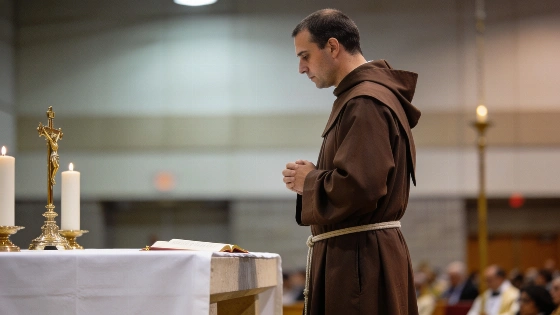
The 1597 uprising followed Pedro de Corpa’s opposition to a Guale leader’s decision to take a second wife. Between 14 and 17 September 1597, violence reached five Franciscan missions serving Indigenous Guale communities along the coast and barrier islands of what is now Georgia. The missionaries were beatified at a bilingual ceremony at the Savannah Convention Center on Saturday, 31 October 2026. More than 10,000 Catholics attended the Mass, which began at 11 a.m. Cardinal Frank Leo, Metropolitan Archbishop of Toronto, presided as papal legate for Pope Leo XIV.
Known collectively as the Georgia Martyrs, the five were Pedro de Corpa, Blas Rodríguez de Cuacos, Miguel de Añón, Antonio de Badajoz and Francisco de Veráscola. Antonio de Badajoz was a lay brother; the other four were friars. They had travelled from Spain to preach the Gospel and serve Guale communities along Georgia’s Atlantic coast, as part of the Spanish Franciscan mission network in the region. The dispute over a baptized Guale heir’s second marriage was followed by attacks at the other mission sites, where the remaining four missionaries were killed. The Church recognizes their deaths as martyrdom in hatred of the faith.
The Church recognized the five as martyrs in January 2025, after Pope Francis authorized the promulgation of the decree concerning their martyrdom. This recognition cleared the way for beatification without a separate miracle being required for the martyrdom cause. During the Savannah Mass, Leo read Pope Leo XIV’s apostolic letter proclaiming the five Blessed. Beatification permits public veneration within the scope authorized by the Church; it is distinct from canonization.
In his homily, Leo described the missionaries as “luminous witnesses to the Gospel” and said martyrdom was a special gift of the Holy Spirit and a source of grace and holiness for the Church. The Savannah ceremony was the first beatification celebrated in Georgia and across the southern United States. On 1 November, Pope Leo XIV referred to the event at the Angelus, naming Pedro de Corpa and his four companions and recalling that they had been killed “in hatred of the faith” in 1597.
Leo connected the beatification with the 250th anniversary of the United States Declaration of Independence and the 800th anniversary of the death of St. Francis of Assisi. He said the Franciscan charism had inspired the missionaries.
The cardinal highlighted their call to holiness and their defence of human dignity. He also pointed to how their understanding of marriage and family shaped their work spreading the Gospel through dialogue and charity. Their example, he said, challenges Christians to remain faithful to Christ while serving others with respect.
Leo urged the faithful to work for unity and reconciliation, saying «la polarización no viene de Dios» (“polarisation does not come from God”, translated from Spanish). He called for prayer and urged reconciliation through concrete acts of charity. During the ceremony, he said, “We do well to lovingly speak their names, for they are holy members of the family of God.”
At the close of his homily, Leo entrusted the faithful to the intercession of the Blessed Virgin Mary and the newly beatified martyrs. He invited Christians to share their faith with courage and joy, saying: «Todavía hoy hay cosas por las que vale la pena vivir y morir» (“Even today there are things worth living and dying for”, translated from Spanish).