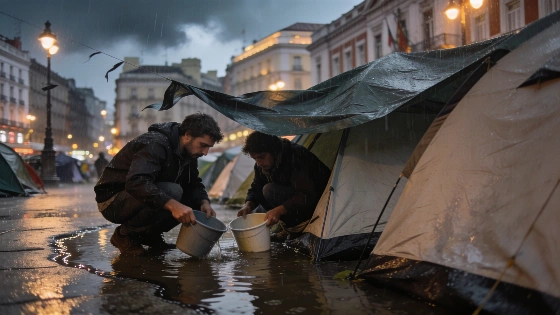
Protesters at Madrid's Puerta del Sol used buckets to clear water from flooded tents during a powerful storm. They still planned to stay overnight as the camp remained a focal point in Spain's housing conflict.
On Tuesday evening, protesters at Madrid's Puerta del Sol used buckets to clear water from flooded tents. Several shelters filled despite their efforts, but demonstrators still planned to spend another night at the site.
Strong winds tugged at awnings and snapped some tarpaulin fastenings, sending pieces of material across the camp. Water ran beneath the tents and stalls, damaging parts of the makeshift installation and disrupting preparations for assemblies on the general strike and the protest's future.
The encampment followed the September 23 eviction of 87-year-old Maricarmen Abascal from the apartment where she had lived for roughly 70 years. Around 1,000 people then spent a week at Puerta del Sol, demanding stronger tenant protection, the Associated Press reported.
The weather was linked to a DANA, described as a reservoir of cold air high in the atmosphere. A trough moving in from the Atlantic met that air mass, helping produce powerful storms over Madrid and nearby areas.
Warnings for Madrid and surrounding areas covered standing water, possible motorway disruption, multiple accidents and major flooding in river channels. People were told to take care, avoid unnecessary travel and check conditions before leaving. Spain's national weather service, AEMET, issued yellow warnings for rain and thunderstorms in Madrid on October 6. Alerts were also active in Andalusia, Castile and León, Navarre and La Rioja.
The October 3 mobilisation took place in Madrid and other Spanish cities. Authorities estimated that about 70,000 people marched in the capital, while the Madrid Tenants' Union put turnout at 500,000, Anadolu Agency reported.
As the storm intensified, protesters worked to limit the damage. The camp forms part of a wider political mobilisation in the capital. Madrid's left alliance had also held political talks, covered in earlier political talks. Tension rose after parliament rejected two government proposals to strengthen protection for vulnerable tenants and help prevent evictions.
Protesters have made the so-called "Maricarmen law" their basic demand. The package calls for measures against evictions and stronger tenant protection.
Juan Díaz, a spokesperson for Izquierda Revolucionaria in Madrid and the Sindicato de Estudiantes, said the camp was being prepared as a base for extending the general strike into neighbourhoods. He said local groups could support one another through the Puerta del Sol encampment and use it as a shared point of action.
The site now includes assemblies, assistance areas, medical facilities and logistical facilities. It has grown beyond a temporary protest camp.
Organisers have called for a nationwide general strike over housing and are also negotiating with trade unions. Gonzalo Álvarez of the Madrid Tenants' Union said the goal was a strike capable of paralysing the country and forcing political change. Media reports said the government also planned to reapprove housing decrees on October 6 before sending them to the Permanent Council for consideration.
That plan remains contested.
Álvarez also warned that removing the camp would not end the mobilisation. Díaz said a forced departure from Sol would lead to larger camps and demonstrations later. He described the approaching general strike date as an achievement for the protest.
The storm exposed the camp's physical vulnerability, but did not end its political purpose. Flooded tents and torn tarpaulins became problems to manage, not reasons to leave.
Parliament's rejection of the housing measures, preparations for new decrees and the size of the October demonstrations point to protests continuing after the weather improves. The housing demand remains active at Puerta del Sol, even when the square becomes difficult to occupy.