At La Palma, four large instruments are designed to turn toward alerts from other observatories in seconds. That response could capture high-energy gamma-ray signals before some bursts fade.
Gamma rays leave no direct image for these telescopes. Instead, they record brief flashes of optical light created in Earth’s atmosphere when gamma rays interact with particles in the air. The four Large-Sized Telescopes, or LSTs, on La Palma are designed to point toward an alert within seconds. Fast cameras capture the flashes, giving researchers a chance to observe fleeting cosmic events before some signals disappear.
That speed matters. Scientists have detected particles with extraordinary energies without always identifying the objects or events that produced them. Rapid follow-up could connect those particles to their sources and reveal the physical processes at work. CTAO is being built to study some of the Universe’s most energetic phenomena. Its targets include gamma-ray sources and cosmic-particle acceleration, as well as rapidly changing astrophysical events.
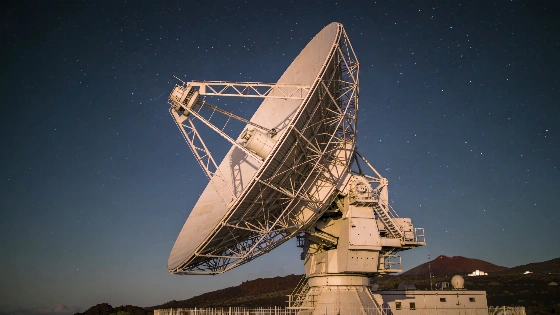
Each La Palma LST stands about 45 metres tall, with a 23-metre-diameter mirror, and weighs around 100 tonnes. Its movable structure can turn in less than 20 seconds. That gives the telescopes a chance to begin observations while a signal is still available, then track changes in brightness over shorter intervals. Researchers hope the approach will help them investigate weaker or more distant sources.
The LSTs will be part of a wider observatory planned to include more than 60 telescopes at two sites. CTAO-North is at the Roque de los Muchachos Observatory on La Palma; CTAO-South is planned for the Paranal Observatory in Chile. The array will combine telescopes with different capabilities, so measurements of high-energy radiation can be considered alongside information about a source and its evolution. The Gran Telescopio Canarias, or GTC, can provide complementary observations.
The four large telescopes can also operate independently.
Their full value depends on coordination with one another and with other observatories. The project brings together hundreds of scientists and engineers from more than 20 countries. The Instituto de Astrofísica de Canarias, or IAC, describes the La Palma telescopes as a step toward CTAO’s full scientific operation, not the completion of the wider project.
Valentín Martínez Pillet, director of the IAC, said the instruments can be directed toward a specific part of the sky in seconds. Conventional telescopes at the Observatorio del Roque de los Muchachos on La Palma require a traditional protective dome; these do not. Their optics and structure are built to detect short-lived atmospheric flashes that provide clues to incoming gamma rays.
The planned network also includes installations in both hemispheres. The Chilean array will involve the European Southern Observatory, or ESO. Nine additional medium-sized telescopes are planned for La Palma, alongside the large instruments and the observatory’s existing facilities.
An earlier report described political pressures in Spain. For the CTAO project, the operational question is whether the network can respond while a source is still emitting detectable signals.
The project’s scale reflects the technical demands of building a coordinated system. Its scientific promise depends on capturing transient signals in time. Each large telescope is estimated to cost between €25 million and €30 million.