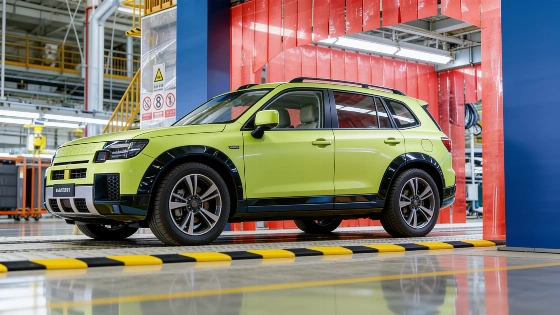
The first Freelander 8 units have left the Chery Jaguar Land Rover factory in Changshu, China, bringing the Freelander name back into production. The SUV will not carry the Land Rover badge: it is the debut vehicle of a standalone brand jointly developed by Chery and Jaguar Land Rover (JLR). The partners describe FREELANDER as a “British Premium Intelligent All-Terrain Brand.” JLR retains ownership of the name and has established a dedicated FREELANDER Design Hub, while Chery contributes vehicle technology, manufacturing capability and its supply network through the Chery Jaguar Land Rover joint venture.
Pre-sales for the Freelander 8 are set to begin on August 10, targeting China ahead of the brand’s international expansion. The project is intended to grow into a family of electrified vehicles, led by the model built in Changshu. The staged overseas rollout is planned to begin in the United Arab Emirates in the first quarter of 2027, with Australia and New Zealand also being prepared for 2027 introductions. Continental Europe is expected to follow in later phases, while the United Kingdom is scheduled for the final stage.
The Freelander name carries large weight among Land Rover enthusiasts, but the new model is a large SUV, not a continuation of the compact vehicle introduced in the 1990s. The China-market version is described as a three-row vehicle with a 2+2+2 seating arrangement. It measures approximately 5,120 mm long, 2,050 mm wide and 1,900 mm high, with a 3,040 mm wheelbase. International versions are reported with five- or six-seat layouts, so seating configurations may vary by market.
For China, the Freelander 8 is specified with a 46.3-inch panoramic dashboard display, a 15.6-inch central touchscreen and a Qualcomm Snapdragon 8397 infotainment processor. Its extended-range electric vehicle (EREV) system uses a 1.5-litre petrol engine as a generator, while electric motors lead the vehicle. The 60.3 kWh nickel-manganese-cobalt (NMC) battery is rated for up to 221 km of electric driving under China’s CLTC test cycle.
The reported international specification is materially different: it uses a plug-in-hybrid system with a 2.0-litre turbocharged petrol engine, a 34.12 kWh lithium-iron-phosphate battery and two electric motors driving all four wheels. Claimed system output is 460 kW and 662 Nm, with a 0-100 km/h time of 5.8 seconds. The international model is rated for at least 110 km of electric driving and at least 886 km of total range under WLTC testing. Those figures use a different test cycle from the China-market CLTC rating and should not be compared directly. International specifications also cite dimensions of 5,118 mm by 2,050 mm by 1,926 mm, a 3,040 mm wheelbase and AC charging of up to 11 kW.
Reported technology features for the international model include a 46.3-inch Mini LED display, Qualcomm’s SA8295P cockpit chip, an AI voice assistant and Level 2+ driver assistance. The vehicle is also positioned for off-road use. Reported equipment includes dual-chamber air suspension, a mechanical front differential lock, an electronic limited-slip rear differential and a maximum wading depth of up to 900 mm. The China-market specification lists towing capacity of up to 2,000 kg.
The brand’s structure separates the Freelander identity from the Land Rover badge while combining JLR’s design and brand expertise with Chery’s China-based industrial platform. Chery has a basic role in technology, manufacturing and supply, while JLR retains ownership of the FREELANDER brand and leads its design direction. The planned overseas rollout makes the Freelander 8 the first step in a broader international expansion, rather than a China-only revival of the name.
Land Rover introduced the original Freelander in the late 1990s as a smaller, more accessible alternative to the marque’s traditional models. The new Freelander 8 reflects a different market strategy: a premium electrified SUV developed through a long-established joint venture, first for China and then for selected international markets. Its China and export specifications also show how the model’s powertrain, battery chemistry and seating options are being adapted for different markets.