Luis de la Fuente once scanned newspapers for coaching jobs in Getxo. Thirteen years later, he led Spain to its second World Cup title. His journey from unemployment to the pinnacle of world football reveals the power of persistence and adaptation.
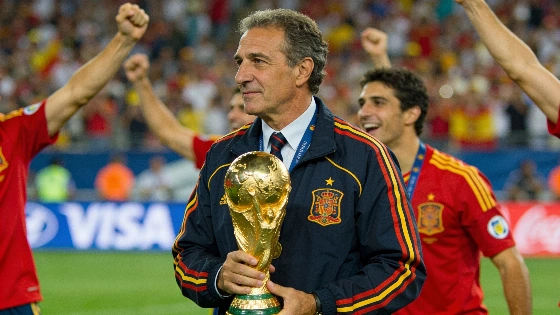
On July 19, 2026, Luis de la Fuente stood on the touchline in New Jersey as Spain clinched its second World Cup, defeating Argentina 1-0. For many, it was a historic sporting triumph. For De la Fuente, it marked the end of a journey that began in far less glamorous circumstances: reading job listings over breakfast in a bar in Getxo, searching for a way back into football after months without work or income.
Years before lifting the trophy, De la Fuente faced a crossroads. With a family to support and no team to coach, he relied on a daily ritual—buying the morning paper, hoping to spot an opportunity that would keep him connected to the game he loved. As he later recounted in his autobiography, La vida se entrena cada día, the pressure was real: "I had a wife and children, I needed to earn a living, but I also needed to return to football."
The turning point came in 2013, when a small ad from the Spanish Football Federation (RFEF) caught his eye. The organization was seeking a coach for its youth teams. De la Fuente applied, not through connections or high-profile recommendations, but by responding to a vacancy that could have easily gone unnoticed. By May of that year, he was leading Spain’s under-19 squad—a modest start that would shape the next decade of his career.
Building from the Bottom
De la Fuente’s path through the RFEF was anything but meteoric. Over thirteen years, he worked his way up, guiding the under-19s to a European title in 2015, the under-21s to another in 2019, and earning Olympic silver in Tokyo. In 2023, he took charge of the senior national team. Success followed: the Nations League in 2023, the European Championship in 2024, and finally, the World Cup in 2026.
This steady progression explains why De la Fuente places such value on process and patience. His ascent was marked by setbacks and periods of uncertainty, but also by a willingness to adapt and prove himself at every level. The experience of working with different generations of players and taking on new responsibilities shaped his approach to leadership and team management.
Lessons in Resilience
De la Fuente’s story resonates with anyone who has faced a disrupted career. As he notes in his book, experience matters, but so does the ability to embrace new opportunities and demonstrate how past challenges have been overcome. His journey is a reminder that even the most decorated coaches can find themselves starting over, relying on persistence and adaptability to move forward.
His autobiography, published in May 2026 with journalist Eduardo Verdú, delves into these themes—leadership, trust in youth, handling pressure, and the conviction that no player is bigger than the team. Notably, the book was completed before Spain’s World Cup victory, making its reflections on uncertainty and process all the more poignant in hindsight.
Letting Go of Criticism
De la Fuente has also spoken openly about the personal toll of public scrutiny. In a conversation recorded in Las Rozas for La Plaza del Pueblo, he described how he learned to distance himself from constant criticism, allowing him to make decisions with greater independence. "A long time ago, I stopped living in fear of criticism," he said, emphasizing the importance of focusing on one’s own judgment rather than external noise.
This mindset aligns with the central message of his book: results are the product of countless decisions, habits, and responsibilities. De la Fuente’s career is not a simple success story—it includes unemployment, financial worries, doubts, and the need to prove himself repeatedly within the federation’s structure.
Context and Perspective
Thirteen years after answering that newspaper ad, De la Fuente lifted the World Cup with Spain. The months of uncertainty did not disappear; instead, they became an essential part of the story he now tells. His journey began with a family to support and a newspaper on the table, continued through the youth ranks, and culminated—at least for now—in the greatest achievement in Spanish football since 2010.
Stories of perseverance and craft are not unique to football. At Inés Rosales, for example, mastering the art of hand-shaped tortas requires months of training and rare skill, as explored in a recent look inside Spain’s demanding food traditions. Both journeys highlight how resilience and dedication, whether in sport or industry, can quietly shape national success.