At Inés Rosales, each worker spends half a year learning to shape 10,000 olive oil tortas daily. The process demands rare manual skill, constant visual checks, and a tradition that technology cannot replace. Only a fraction of candidates succeed.
In the Huévar del Aljarafe factory of Inés Rosales, a single worker can shape up to 10,000 olive oil tortas by hand in one shift. Achieving this pace is not a matter of simple repetition—it requires six months of intensive training and a level of manual dexterity that few candidates ever reach. According to Juan Carlos Espinosa, the company’s general director, the process begins with a test of natural ability. Only those who demonstrate the right touch and coordination are invited to continue.
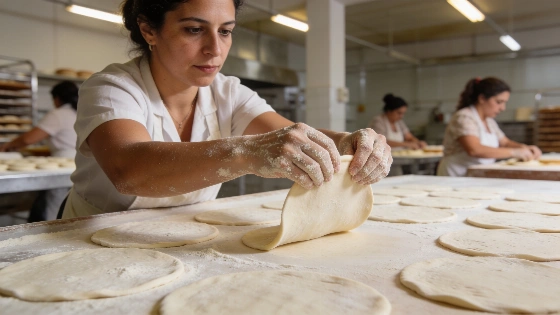
Espinosa explains that mastering the signature movement is a gradual process. Trainees work alongside experienced labradoras, learning to replicate the precise gesture needed to flatten each piece of dough. The goal is to develop muscle memory so refined that the hands move almost automatically, without constant visual guidance. For many, progress stalls after a few months; only about 10% of those who start the training reach the required speed and consistency.
Precision in Every Gesture
Throughout production, workers rely on screens that display real-time images of the tortas as they move down the line. These visual checks are crucial: a torta that is too thin will caramelize and darken in the oven, while one that is too thick remains pale and undercooked. The system allows each labradora to adjust her technique on the fly, maintaining the delicate balance of size, thickness, and shape that defines the product.
Despite advances in automation, the final shaping of each Torta de Aceite Original remains a manual task. The official product specification confirms that while machines divide the dough into equal portions, only human hands can achieve the traditional finish. Attempts to mechanize this step have failed to preserve the unique texture and flavor that distinguish the brand.
A Tradition Shaped by Women
All of the labradoras at Inés Rosales are women—a fact Espinosa attributes to the company’s experience rather than policy. Since its founding in 1910 by Inés Rosales Cabello, the craft has been passed down through generations of women from Castilleja de la Cuesta. The company moved to its current location in 1991, but the core method remains unchanged. According to the European Union’s 2013 registration of “Tortas de Aceite de Castilleja de la Cuesta” as a Traditional Speciality Guaranteed, manual shaping and olive oil are the two defining elements of the product.
Each day, 16 labradoras per shift help produce around 300,000 tortas, with every piece passing through skilled hands before baking. The company does not currently advertise open positions or recruitment drives, underscoring the exclusivity of the role and the difficulty of mastering the craft.
Technology Meets Tradition
While the process is rooted in tradition, Inés Rosales has integrated modern quality controls. The production line uses a Hazard Analysis and Critical Control Points (HACCP) system to ensure traceability and food safety. Visual feedback from the screens helps workers maintain standards without replacing the human element. This blend of technique and oversight is echoed in other Spanish food businesses, but the scale and intensity at Inés Rosales set it apart.
The challenge of balancing heritage and innovation is not unique to the food sector. For example, the integration of new technology in traditional industries often sparks debate, as seen when France deployed the Airbus A400M firefighting kit while Spain awaited certification—a move that highlighted the tension between established methods and modern solutions. (Read how France’s rapid adoption of new firefighting technology contrasts with Spain’s approach.)
Protecting a Recognized Method
The six-month training period at Inés Rosales is more than a rite of passage; it is a safeguard for a method recognized across Europe. The company’s insistence on manual skill ensures that each torta meets the standards that have defined the brand for over a century. In a sector where efficiency often trumps tradition, this commitment stands out as both a challenge and a point of pride.