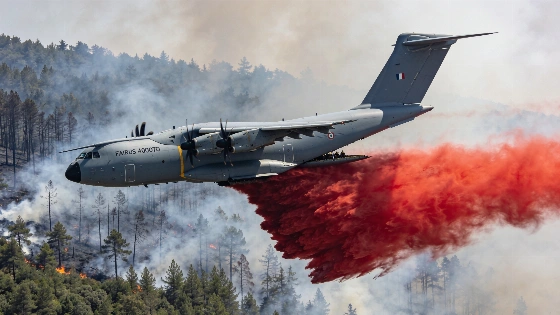
On July 25, France became the first nation to use the Airbus A400M firefighting kit in an actual wildfire, releasing up to 20,000 liters of fire retardant in less than ten seconds. Airbus Defence and Space developed the removable system to turn the military transport aircraft into a high-volume aerial firefighting platform without permanent structural modifications. France’s experimental deployment came as Spain, an early test partner with a fleet of 14 A400Ms, continued to await operational certification for its own aircraft.
France authorized the system under a July 17, 2026 agreement involving Airbus Defence and Space, the Ministry of the Interior and the Ministry of the Armed Forces. The arrangement enabled integration of a 20-tonne retardant capability over a 14-day transition period. France’s Directorate General for Civil Security and Crisis Management took part in flight validation, and government spokeswoman Maud Bregeon announced the deployment on July 23. One French Air and Space Force A400M was equipped for the experimental mission, while a group of military crews underwent mission qualification. The arrangement provided seasonal surge capacity; it did not convert the wider fleet.
The timing coincided with exceptional pressure on French firefighting resources. The Saumos fire in Gironde began on July 22 and burned about 42,000 hectares, while preventive evacuations affected approximately 220,000 people near the Arcachon basin. In the Landes, a retardant-filling facility operated for 35 days during 2026, compared with 11, four and eight days in the preceding years. It completed nearly 158 refills and delivered 195 tonnes of retardant, showing the demand on ground-based support for aerial operations.
Spain’s Fleet Still Awaits Certification
Spain’s Air and Space Force operates 14 A400M aircraft, with a fifteenth on order. None had been cleared for firefighting missions at the time of the French deployment. The process requires technical validation and flight testing, followed by crew training and regulatory approval. Although initial plans called for equipping at least one Spanish aircraft in 2026, no operational entry date had been set. Airbus referred questions about the timeline to Spain’s Ministry of Defence. Spain’s connection to the project is both operational and industrial: the A400M is assembled in Seville, and Spanish crews supported the early flight trials.
Airbus began validating the firefighting concept in Spain in July 2022 with support from the Air and Space Force’s 43rd Group. Early trials included a release of 20 tonnes of water in under ten seconds at about 230 km/h and 46 meters above ground. Further testing followed in 2023. In April 2025, French trials examined low-altitude drops from below 30 meters and assessed how retardant was distributed and concentrated across the ground. The French use in 2026 was the kit’s first reported deployment in a real wildfire.
How the Kit Works
The roll-on/roll-off module sits inside the A400M’s cargo hold. Its tank carries up to 20,000 liters of water or retardant, discharged by gravity through outlets at the rear ramp. The installation is removable and requires no permanent airframe modification, so the aircraft can return to its transport role when the kit is removed. The system is designed to empty its load in less than ten seconds. Conventional ground pumps can reportedly refill the tank in under ten minutes.
A single A400M load is described as roughly equivalent to 3.3 loads from a Canadair CL-415 amphibious water bomber. Under optimal conditions, a drop can form a firebreak 400 to 500 meters long. The A400M can lay down a large volume of retardant ahead of advancing flames or around critical infrastructure, but it must return to an airbase to reload. The CL-415 can scoop water from lakes or the sea, then resume operations without returning to an airfield. The aircraft complement each other: the A400M adds high-volume capacity, while amphibious tankers make repeated water drops close to the fire.
From Testing to Real-World Use
The French deployment was experimental and did not amount to a fully mature, permanently certified firefighting fleet capability. It showed how an aircraft already used for military airlift can add capacity during a severe fire season while retaining its basic transport role. Spain’s A400M fleet, with further aircraft planned for delivery from 2028 to 2029, remains separate from that French operational trial.
Interest in the modular approach extends beyond France and Spain. Aviation Week has reported plans for the United Kingdom to equip Royal Air Force A400Ms and Chinook helicopters for future aerial firefighting missions. Those plans followed a 2026 heatwave during which the country experienced more than 1,300 wildfires. The reports point to wider interest in adapting military aircraft for emergency response, while the A400M kit is intended to reinforce established firefighting platforms, not replace them. For a closer look at how Spain’s Canadair pilots operate during high-stakes missions, see this report on precision water drops in Madrid and Ávila.