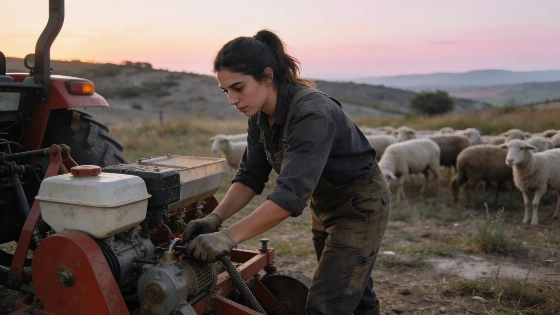
At 26, Elena Burillo starts work before sunrise and often finishes long after dusk. She has traded a police uniform for work boots, dividing her time between livestock and fields near Zaragoza. Leaving preparations for the Policía Nacional to run her own agricultural business has brought uncertainty, but also a sense of purpose.
Elena did not always expect to follow her family’s rural path. Although she grew up surrounded by agriculture, she was repeatedly told the sector offered little future. After finishing her studies, she spent years preparing for police entrance exams, then decided the career was not right for her. Several short-term jobs followed. At 21, she enrolled in a higher degree in viticulture, and a stint in Bordeaux working with agricultural machinery helped convince her to return to the land. Back in Spain, she began a degree in Agricultural and Rural Engineering and bought her first flock of sheep. With support from her father and uncle, she gradually built up her own operation.
Long Days, Relentless Demands
During peak seasons, Elena’s workday can run from 7:00 a.m. to 10:00 p.m. Mornings begin in the barn, where she tends newborn lambs and feeds ewes. She harvests and bales crops, then irrigates fields and prepares them for new planting. The day also brings the logistics of selling produce and livestock. Her work spans animal care and field operations, alongside the daily demands of running a business. Despite the workload, Elena is determined to expand rather than scale back, describing her work as “an ambition, not just a job.” She hopes her sister, who currently lives in the Netherlands, might one day return to share the burden.
Weather and Markets: Unpredictable Risks
For Elena, the greatest challenge is unpredictable weather. Months of investment can be wiped out by drought or a single storm. Equipment breakdowns and fluctuating market prices add pressure, while income is never guaranteed. Early in the business, she relied on loans to invest in machinery and livestock, with returns taking time to materialize. She says sheep farming has recently benefited from higher prices, while rising fuel and input costs have squeezed margins in crop production. In her view, combining livestock and crops helps balance losses and weather market volatility. Her account also reflects pressures she says Spanish farmers face: some may have to discard crops rather than sell at unsustainable prices, a dilemma explored in stories like the urgent demand for skilled workers in Spain’s rural sectors.
Spain’s agricultural sector operates within policy frameworks overseen by national and European authorities, while the finances of an individual farm depend on its own costs and output, with market conditions shaping the result. For Elena, that calculation plays out season by season: weather and machinery affect her operation, while fuel costs and prices hit its two parts differently.
Gender and Scale: Extra Hurdles
Elena says being a woman in agriculture means constantly having to prove her capabilities, particularly when some people assume she relies on male relatives for physical tasks. Social media brings another layer of scrutiny: followers sometimes question whether she does the work herself. She sees more young people at agricultural fairs and believes the image of rural life is slowly changing, but warns that small farms face mounting pressure. In her estimate, where 20 hectares once sufficed, 200 are now needed to remain viable. She argues that the expansion of intensive farming and land purchases by investment funds threaten the future of small, family-run operations.
Despite the obstacles, Elena remains committed to her path. Her experience brings together the personal cost and the satisfaction of building something of her own in a business where each season brings new risks, and sometimes new hope.