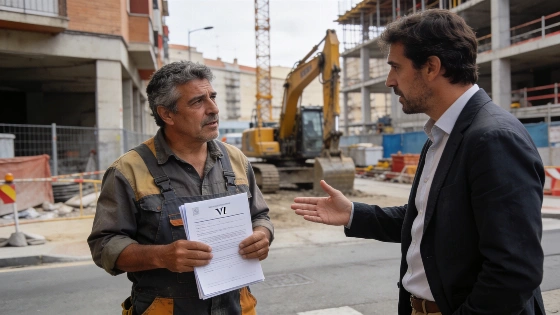
Matías Armani, a 48-year-old Argentine bricklayer, received ten job offers just two days after arriving in Spain. His experience underscores the urgent demand for experienced tradespeople in the Spanish construction sector, where younger workers remain scarce.
Matías Armani, a 48-year-old bricklayer from Argentina with over two decades of experience, landed in Spain and found himself fielding ten job offers within just two days of distributing his CV. Without any local contacts or prior network, he quickly became a sought-after candidate among construction firms, ultimately choosing one employer from the many interested.
His story, shared on the TikTok account @tuobraperfecta, has drawn attention to the acute shortage of skilled labor in Spain’s construction industry. “If you know how to work in construction, you’ll find a job very quickly,” Matías explained, reflecting on his swift success. While his case is individual, it mirrors a broader reality: experienced bricklayers remain among the most in-demand roles in the sector.
Shortage of Skilled Workers
According to the Industrial Construction Observatory, the sector employed 1,612,000 people in the second quarter of 2026, a 5.7% increase from the previous year. In the first two months of the year alone, bricklayers accounted for 42,245 contracts—nearly 29% of all new hires in construction. The rapid response Matías received is largely attributed to his extensive experience and mastery of the trade, qualities that are increasingly rare as fewer young people enter the field.
Matías points to a generational shift: “In my family, you either studied or learned a manual trade from adolescence. My father always said, if you learn a trade, you can take it anywhere.” He believes the decline in young tradespeople is linked to changing attitudes and a loss of traditional skills among younger generations.
Youth and Foreign Labor in Construction
Recent data shows 181,000 workers under 30 in construction during the second quarter of 2026, representing just 11.2% of the workforce—a modest increase, but still far from a generational renewal. In contrast, workers aged 50 and above now make up 38.1% of the sector, with those over 60 reaching a five-year high at 9.8%. The workforce is aging, and the influx of young talent remains limited.
Foreign labor is playing a growing role, now accounting for 27.4% of construction workers, up 2.2 points from the previous year. Matías’s experience fits this trend, though the specific reasons behind the ten job offers he received—and the terms of each—remain unclear from available data.
Wages and Working Conditions
Matías estimates that a skilled bricklayer on the Costa del Sol can earn between €1,500 and €1,800 per month, though he does not specify whether this is gross or net, or if it includes bonuses or extra payments. Actual salaries vary widely depending on province, professional category, experience, and contract terms. The national minimum wage for 2026 is set at €1,221 per month in 14 payments, or €17,094 gross annually, with sector agreements requiring a 3% increase in provincial wage tables from January 2026.
Before accepting a job, workers are advised to check the annual gross salary, number of payments, working hours, professional level, overtime, contract duration, and social security registration. Without these details, it is difficult to compare offers or assess their true value.
Legal Requirements for Foreign Workers
Matías’s story does not clarify his administrative status upon entering the Spanish labor market. Generally, non-EU citizens require an initial residence and work permit, which must be requested by the employer. The Ministry of Inclusion, Social Security and Migration outlines the necessary steps and documentation for this process. Receiving multiple job offers does not guarantee legal employment unless the proper permits are in place.
While Matías’s rapid job search highlights the value of experience in a sector hungry for skilled labor, it also reflects the ongoing demographic challenges facing Spanish construction. The industry continues to grow, but the need for generational renewal and improved working conditions remains unresolved.