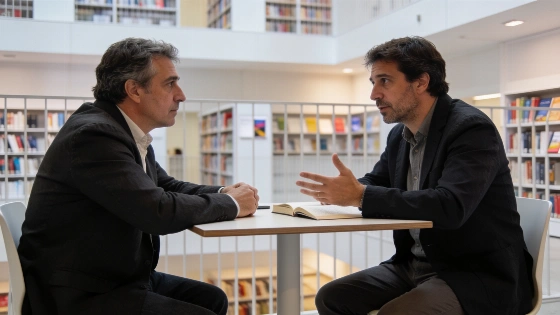
Two girls from very different backgrounds meet on a roller coaster, and their friendship grows through the liberating force of screaming. In Gabi Martínez’s novel ‘Gritadero’, the encounter leads to a clandestine community whose members scream rather than fight physically. Catharsis becomes a form of dissent. The story is set on the outskirts of Barcelona and marks Martínez’s return to urban fiction after his travel-writing work. That premise will anchor a Granada conversation on Tuesday 17 November, when Martínez meets writer Jesús Ortega to discuss the novel at 19:30.
The event is organised by the Centro Andaluz de las Letras at the bibliotecas de Andalucía y Pública y Provincial. The centre depends on the Consejería de Cultura, Patrimonio Histórico y Deporte and is managed by the Agencia Andaluza de Instituciones Culturales. The November programme also includes a Bilbao presentation on 13 November at Librería Cámara. A Córdoba event follows on 16 November at 19:00 in the Biblioteca Pública Grupo Cántico, where Martínez will appear with poet Pablo García Casado.
In ‘Gritadero’, the girls’ shared experience of shouting becomes a way to challenge conventions and push boundaries. The publisher-linked synopsis names the protagonists Tanit and Lupe, and describes their friendship as the seed of an unexpected revolt. Martínez has presented shouting as a form of expression that is “tan elemental como radical” (“as elemental as it is radical”). Random House publishes the novel. The ebook edition carries ISBN 9788439747352.
The novel’s clandestine community begins with screaming as catharsis, then raises questions about who is allowed to speak and when power treats a raised voice as a threat. In a literary feature, La Vanguardia compared the non-physical group to secret combat circles: the characters do not touch one another, but shout until they lose their voices. The feature also linked the story’s urban setting to the surrounding noise of traffic and mobile phones, alongside advertising and media carried through social networks.
A US film-adaptation project based on the novel has also been reported. Filmmakers Mariana Rondón and Marité Ugás are attached to the project. Producer Leopoldo Goût is also involved. The novel’s public presentation frames the group’s movement from individual release to collective dissent.
Martínez’s work covers fiction and essays, alongside travel writing. His non-fiction titles include ‘Sólo para gigantes’. The list also includes ‘Un cambio de verdad’ and ‘En la Barrera’. His non-fiction bibliography further includes ‘Naturalmente urbano’ and ‘Lagarta’. His novels include ‘Sudd’ and ‘Voy’; ‘Las defensas’ is another. ‘Delta’ was named the best book of 2023 by WMagazine.
He directs Festival LiterNatura and co-directs Animales invisibles. He has also worked as a screenwriter. His regular contributions include National Geographic and El País, while his bylines also appear in Sumaúma and Altaïr. He contributes to The Ecologist as well.
Ortega is a writer and cultural manager. He graduated in Hispanic Philology from the University of Granada and holds a Master’s in Cultural Management (UGR). He also completed a Master’s in Publishing (Santillana-USAL). His other postgraduate qualification is a Master’s in Literary and Theatre Studies (UGR). From 1997 to 2015 he coordinated cultural activities at the Huerta de San Vicente, Casa-Museo Federico García Lorca. Since 2015 he has coordinated Granada Ciudad de Literatura for the city council’s culture department, overseeing activities linked to Granada’s membership of the UNESCO Creative Cities Network. He has published short-story books and essays, and contributed to various publications. RUSSPAIN’s earlier cultural listings included a preview of a Valencia concert scheduled for 15 November.