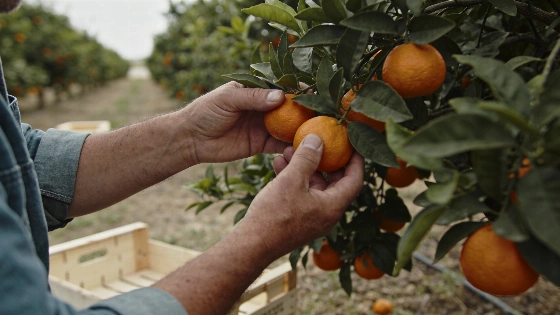
Huelva’s citrus sector generates 1.3 million jornals, according to VOX Senate candidate Carlos Bermejo. He says growers need protection from unequal competition and rising production costs. Bermejo set out the demands during a visit to Los Bresnos Sociedad Cooperativa in Cartaya.
Bermejo argues that EU rules place increasingly strict requirements on Spanish farmers, while imported produce may face different standards. He warned that plant pests entering through imports could threaten local farms. Spanish plant-health guidance identifies huanglongbing, or citrus greening, as a quarantine pest in the EU and Spain, along with its insect vectors, the African and Asian citrus psyllids, Trioza erytreae and Diaphorina citri. Spain’s prevention programme for the disease is set out under Royal Decree 23/2016.
EU plant-health controls assess pest risks and measures to reduce them. Under European Commission rules, a third-country national plant-protection organisation must request a temporary derogation. Its technical dossier must identify pests potentially associated with the relevant plant or product and describe how the exporting country mitigates the risk, including through inspections. The European Food Safety Authority describes its assessment process as comparing the consequences of combinations of measures used to reduce phytosanitary risk.
His proposals include applying mirror clauses so imported products meet equivalent requirements. He also called for stronger phytosanitary checks at the border and rejection of the EU-Mercosur trade agreement, which he says could intensify unfair competition for Spanish producers. Border measures apply to specific products: the European Commission’s TARIC database lists an official plant-control measure for fresh lemons under tariff code 0805 50 90 00 from 29 October 2025, as well as an additional-duty measure from 20 July 2025.
Trade data provide broader context for the debate: Spain imported 218,348 tonnes of fresh oranges, worth about US$148 million, in 2024. Egypt and South Africa were listed among the principal source countries, with Portugal also on the list. The figure concerns fresh oranges and does not distinguish Huelva’s citrus market. VOX has also raised other concerns in the province, including policing, in a separate Huelva report. The citrus visit focused on agricultural policy. Bermejo called for an end to what he described as burdens imposed by the European Green Deal and the 2030 Agenda, and urged simpler administration for farmers.
He also advocated reducing production costs and strengthening agricultural insurance. On the Common Agricultural Policy, he says funding should remain sufficient, without cuts or new requirements he considers ideological.
Huelva is Andalucía’s second-largest citrus-producing province and its leading producer of mandarins, according to the figures cited by Bermejo. He said the sector supports thousands of families and contributes to employment and wealth in the province.