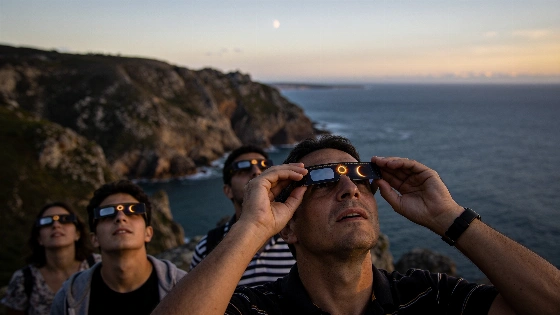
Galicia will be the first region in Spain to witness the total solar eclipse. Authorities have banned access to 29 popular viewing spots for safety. The event will affect 143 municipalities and attract significant attention.
Galicia is preparing for a rare astronomical event as the total solar eclipse will first touch Spanish soil in this region. While 143 municipalities fall within the path of totality, the Xunta de Galicia has imposed strict access restrictions, closing 29 well-known sites due to safety concerns. This decision directly impacts some of the most sought-after coastal and mountain viewpoints, including Praia das Catedrais in Ribadeo and the Torre de Hércules in A Coruña.
The eclipse is expected to draw large numbers of residents and visitors, especially in the provinces of A Coruña and Lugo, where anticipation has been building for months. Local authorities and event organizers have arranged special transport and cultural activities, such as bus transfers to the San Antón de Corveiro viewpoint in Cedeira, where the eclipse will coincide with a live performance by Xabier Díaz as part of the Festival Jazz de Ría. However, the latest weather forecasts indicate that cloud cover may affect visibility along parts of the Galician coast.
The partial phase of the eclipse will begin in A Coruña around 19:31, with totality expected at approximately 20:28 and the phenomenon concluding by 21:22. In some northern municipalities, such as Cedeira and Ribadeo, the period of complete darkness will last over a minute and a half, offering a rare spectacle as the sun sets over the Atlantic. Mountain areas like Os Ancares, known for their clear skies, are also expected to attract eclipse watchers.
Despite the region's natural advantages, the Xunta's ban covers a diverse list of locations across all four Galician provinces. In A Coruña, sites such as the islotes de San Pedro, Monte Pindo, and the beach of Carnota are off-limits. Lugo's restrictions include the castillo de Castrodouro, Fuciño do Porco, and the Acantilados de Papel in Xove. Pontevedra has closed Xestoso, Fervenza do Toxa, and the Monte da Guía viewpoint in Vigo, while in Ourense, the Mirador de San Martiño de A Rúa is also prohibited. These measures are intended to prevent overcrowding and ensure public safety during the event.
Galicia's unique position means it will experience the latest sunset on the Spanish mainland during the eclipse, allowing the spectacle to continue as the sun disappears into the sea. The combination of natural beauty and astronomical rarity has heightened interest, but the restrictions highlight the balance between public enthusiasm and safety management. Similar security and mobility challenges have been reported in other regions, as seen in Catalonia's preparations for the eclipse, where authorities have coordinated extensive plans to handle visitor influx and enforce safety protocols (Catalonia's eclipse readiness).
For context, total solar eclipses are infrequent in Spain, with the last visible event occurring decades ago. The next opportunity for such a phenomenon in the region is not expected for generations. The current restrictions reflect lessons learned from previous large-scale gatherings at natural landmarks, where uncontrolled crowds have led to safety incidents and environmental damage. The authorities' approach in Galicia underscores the importance of balancing public access with risk management during high-profile natural events.