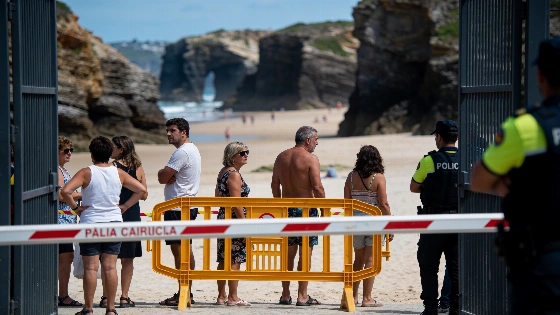
A sudden influx of visitors forced authorities to restrict access to Praia das Catedrais in Galicia, reigniting Spain’s debate over beach capacity, paid services, and public access. The incident highlights the challenges of balancing tourism and conservation on Spain’s most iconic shores.
On July 21, access to Praia das Catedrais in Ribadeo, Lugo, was abruptly halted as thousands of visitors converged during the only daytime low tide. The regional government, Xunta de Galicia, temporarily closed the entrance around 16:30, citing safety concerns as crowds struggled to navigate a narrow passage on the sand. The move did not result from exceeding the daily visitor cap, but from the sheer concentration of people in a short window, exposing the limits of current crowd management strategies.
The episode quickly reignited debate across Spain about how to handle overcrowding on popular beaches. On the radio show «Herrera en COPE», Sofía Buera and Ángel Correas discussed whether Spain should consider stricter time-slot reservations, visitor fees, or even private management models inspired by Italy’s lidos. While no official policy changes are on the table, the conversation reflects growing pressure to rethink how Spain’s most visited coastal sites are managed.
Capacity Limits Under Strain
Praia das Catedrais operates under a conservation plan that restricts daily access to 4,812 people during peak months and Easter. Entry requires prior authorization and ID, aiming to protect the fragile natural monument and spread visits throughout the day. However, with only one low tide on July 21, most visitors arrived at the same time, overwhelming the system. Xunta officials explained that the temporary closure was necessary to clear congestion and ensure safety, not because the daily quota had been breached.
This incident highlights a key flaw: even with strict daily limits, crowding can spike if demand concentrates in a narrow time frame. The situation also reflects a broader trend, as more tourists seek out northern beaches during heatwaves, shifting pressure away from the Mediterranean. As noted in a recent report on changing tourism patterns, such shifts are reshaping how Spanish destinations must adapt to new visitor flows.
The Italian Model: Paid Services and Public Access
Italy’s lido system, discussed on COPE, offers a contrasting approach. Private concessionaires manage large sections of public beaches, providing rows of sunbeds, umbrellas, and amenities for a fee. While these services can improve cleanliness and safety, they also reduce the amount of free, unregulated space available to the public. According to Mare Libero, about 43% of Italy’s sandy beaches are occupied by such establishments, though this figure does not represent the entire coastline or imply private ownership.
The Italian model has sparked ongoing legal and social battles. Critics argue that high prices and shrinking free zones disadvantage locals and those unwilling to pay, while supporters point to better facilities and maintenance. The debate is further complicated by EU directives requiring transparent, competitive concession processes, and by regional differences in how much coastline remains freely accessible.
Spain’s Legal Barriers to Paid Entry
Spanish law is clear: the coastline and sea must remain free, public, and open for activities like swimming and walking. While authorities can license beach bars, sunbeds, and water sports, they cannot turn general beach access into a paid service. Any move toward the Italian model would face significant legal and cultural resistance, as the right to enjoy the beach is deeply embedded in Spanish society.
Instead, experts suggest refining existing tools: enforcing time-slot reservations in protected areas, providing real-time information on tides and occupancy, and temporarily suspending entry when safety is at risk. Promoting lesser-known beaches could also help distribute visitor numbers more evenly. The Praia das Catedrais incident does not signal a need for privatized beaches, but it does show that daily permits alone are not enough when natural conditions funnel crowds into tight windows.
As Spain’s coastal tourism evolves, the challenge will be to balance conservation, public access, and the economic benefits of visitor numbers—without losing the open, communal spirit that defines the country’s beaches.