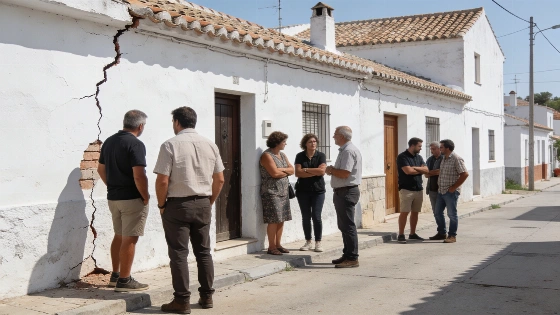
A shallow 1.8-magnitude earthquake was felt in Churriana de la Vega on Friday morning. The tremor is part of a persistent seismic series affecting Granada since mid-August. Residents remain on alert as aftershocks continue.
Granada’s seismic unrest continues, with a new earthquake shaking Churriana de la Vega at 10:08 on Friday morning. Although the tremor registered just 1.8 on the Richter scale, its shallow depth made it noticeable to residents in this metropolitan area, which has been among the hardest hit by the recent wave of seismic activity.
According to the Instituto Geográfico Nacional, a series of earthquakes has been recorded since midnight across multiple municipalities, including La Zubia, Otura, Gójar, Padul, Ogíjares, Loja, Armilla, Monachil, Huétor Vega, Alhendín, Granada, and Churriana de la Vega. Of these, only the event in Churriana de la Vega was felt by the population, and even then, only moderately. The remaining tremors were weaker or occurred at depths of up to 12 kilometers, making them imperceptible at the surface.
This latest activity follows a particularly active Thursday, when eight earthquakes between 2.1 and 2.4 magnitude were felt by residents. The ongoing seismic sequence in Alhendín has been marked by two major quakes on August 15 and 18, both reaching 4.8 magnitude. These stronger events, along with several smaller shocks, have caused significant material damage in Granada and surrounding municipalities. On August 18, three people were injured during one of the most intense episodes.
Between August 14 and 24, the region experienced 1,075 earthquakes as part of this seismic swarm, with most registering below magnitude 2. However, around one hundred were strong enough to be felt. Twelve exceeded magnitude 3, raising alarm among locals, while four surpassed magnitude 4, causing damage now estimated in the millions. The most powerful tremors were felt across more than 500 towns in Andalusia, Murcia, Castilla-La Mancha, and even as far as Madrid.
The current seismic sequence is centered in the Granada basin, an area historically prone to earthquakes due to active fault systems such as those in Granada, Dílar, Santa Fe, and Belicena-Alhendín. A similar pattern was observed in 2021, with Santa Fe and Atarfe as focal points. The persistent seismicity highlights the region’s vulnerability and the ongoing need for preparedness.
While the focus remains on the earthquakes in Granada, other regions of Spain have also faced natural challenges this summer. For example, northern Spain recently dealt with severe storms and heavy rainfall, prompting weather alerts in Galicia. These events underscore the varied natural risks affecting different parts of the country.
Granada’s seismic activity is closely monitored by national authorities, with local governments urging residents to stay informed and prepared. The ongoing swarm serves as a reminder of the importance of seismic safety measures in one of the most earthquake-prone zones of the Iberian Peninsula.