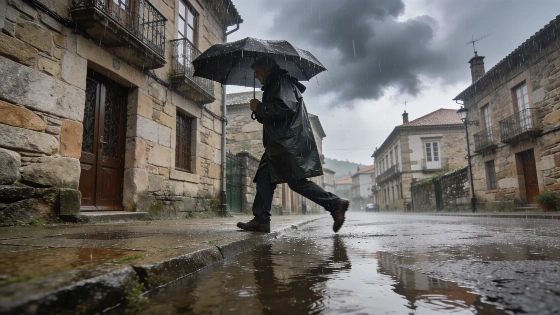
Persistent storms and heavy rainfall are affecting northern Spain, with Galicia facing the most severe conditions. Weather alerts remain in place as temperatures stay unusually low for June. Authorities expect improvement by Friday.
Severe weather continues to disrupt northern Spain, with Galicia experiencing the brunt of heavy rainfall and storms this week. According to the State Meteorological Agency (Aemet), a slow-moving front linked to a new Atlantic low-pressure system is bringing intense precipitation, particularly to the Rías Baixas, inland A Coruña and Pontevedra, and the Miño valley. The situation is expected to remain unstable until Friday, when conditions should begin to stabilize.
Yellow weather alerts have been issued across much of Galicia, warning of hourly rainfall up to 15 litres per square metre and accumulations reaching 40 litres in 12 hours. In western A Coruña, the alert level rises to orange, with forecasts of 30 litres per hour and significant total accumulations. These downpours may be accompanied by thunderstorms, increasing the risk of localised flooding and disruption.
Elsewhere in the north, the Pyrenees in Navarra and Huesca are also on alert as humid air entering through the Ebro valley is expected to trigger storms with hail and strong gusts of wind. In the Aran valley, wind speeds could reach up to 80 kilometres per hour. Meanwhile, the rest of the northern coast, including Asturias and the western part of Castilla y León, will continue to see temperatures well below seasonal averages, prolonging the unseasonably cool spell.
While the Atlantic front will not reach the Mediterranean, a rise in temperatures is forecast for the Ebro valley, inland Gipuzkoa and Bizkaia, and the Cantabrian side of Navarra. The highest temperatures are expected in the central Ebro valley and parts of Granada and Almería, where values could approach 38°C. In contrast, the west will remain mostly cloudy with further showers and isolated storms, while the south will see clearer skies and the east may experience brief, light showers with occasional strong winds.
Additional weather phenomena are also causing concern. Menorca is under a yellow alert for rissagas—sudden sea level changes caused by atmospheric pressure shifts—while Saharan dust is forecast to reach the southeast and, more notably, the Balearic Islands. The risk of wildfires is rising sharply in central and eastern Spain due to high temperatures and strong winds, with authorities warning of very high or extreme danger in these areas.
Spain's varied climate often leads to sharp contrasts between regions, especially during transitional seasons. Galicia, with its Atlantic exposure, is particularly vulnerable to intense rainfall and rapid weather changes. The current pattern highlights the importance of localised weather alerts and the need for residents to stay informed. As the country heads into summer, authorities continue to monitor conditions closely, balancing the risks of flooding in the north with wildfire threats in the drier central and eastern regions.