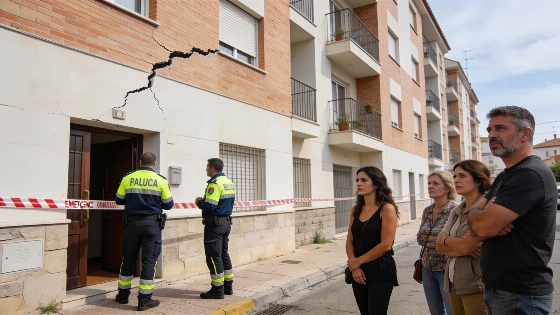
A wave of nearly 700 earthquakes has shaken Granada and its suburbs. Over 600 residents remain evacuated from Las Gabias due to structural damage. Authorities are conducting safety checks before allowing returns.
Granada and its metropolitan area have experienced an intense seismic sequence, with around 700 earthquakes recorded since August 14, according to the Instituto Geográfico Nacional (IGN). While most tremors were too weak to be felt, several stronger quakes this week forced the evacuation of more than 600 residents from Las Gabias, where buildings suffered visible structural damage. Technical inspections are underway to determine when it will be safe for families to return home.
The most significant shocks occurred on Tuesday, when seven high-magnitude earthquakes were registered in quick succession. The strongest, a 4.8-magnitude event, struck near Gójar at 10:37 a.m., close to the site of a 5.0-magnitude quake just days earlier. Four of Tuesday’s tremors exceeded magnitude 4, causing widespread alarm, the suspension of medical services, and scenes of panic in several towns. Emergency services responded to falling debris, cracked walls, and people trapped in elevators, with the 112 Andalucía coordination center handling over 5,500 calls since August 15.
Las Gabias remains the most affected municipality. The local council confirmed that emergency reinforcement of damaged building pillars has been completed, and technical teams are now assessing the safety of 371 evacuated homes. The preventive evacuation order will stay in place until all safety conditions are verified. The mayor of Las Gabias has publicly thanked residents for their patience and cooperation during the disruption.
Experts note that the current seismic sequence closely resembles the “enjambre sísmico” that hit Granada between December 2020 and August 2021, when over 3,100 earthquakes were recorded. However, specialists caution that it is too early to classify the recent activity as a new seismic swarm, as further monitoring is needed in the coming weeks. On Friday, two minor tremors of 2.5 and 2.1 magnitude were felt in La Zubia and Armilla, both with weak intensity and brief duration. Throughout the day, about fifteen minor quakes were registered, most below magnitude 2 and unnoticed by the public.
In response to the ongoing risk, building safety has become a renewed focus. According to Javier Lafuente, a professor at the University of Granada, modern construction in the city and its suburbs has generally performed well during the recent earthquakes, thanks to updated building codes since the 1970s. He highlights the potential of hydraulic damping systems, which absorb seismic energy and could further improve structural resilience in earthquake-prone regions like Andalusia, Murcia, and the Levante.
Severe weather events have also tested emergency response in Spain’s regions. For example, violent storms recently caused major damage in Valencia province, prompting similar large-scale interventions by local authorities. Such incidents underline the importance of robust infrastructure and coordinated crisis management in the face of natural hazards.
Granada’s recent seismic activity serves as a reminder of the region’s vulnerability to earthquakes. While most tremors remain minor, the disruption to daily life and the need for mass evacuations highlight the ongoing challenge of ensuring safety in areas with active fault lines. The IGN and local authorities continue to monitor the situation closely, with further updates expected as technical assessments progress.
Spain is among the most seismically active countries in Western Europe, particularly in the south and southeast. The country’s building regulations have evolved to address these risks, but older structures may still be vulnerable. The experience in Granada underscores the need for continued investment in both prevention and rapid response capabilities.