Granada’s Réquiem por Lorca runs from Thursday to Sunday, marking the 90th anniversary of the poet’s killing and remembering victims of Francoist repression. Eleven performances will take place across the city.
From 15 to 18 October 2026, venues across Granada will host a four-day artistic funeral for Federico García Lorca and those killed by Francoist repression during the Spanish Civil War. The event marks the 90th anniversary of the poet’s killing. Created at the invitation of the Fundación Federico García Lorca, the project is led by artistic directors Pep Olona and Maral Kekejian. Its programme draws on dance and music, with literature woven through the performances.
The programme links Lorca’s work with Mozart’s Requiem. Its 11 pieces are arranged in four acts, tied to water and earth, then fire and air. Around 50 artists and collectives are taking part. More than 400 voices will perform in the choral programme. Organisers describe the project as an act of shared memory and public reparation. They also frame it as collective mourning, not a festival.
That purpose shapes the event. Artistic directors Pep Olona and Maral Kekejian say audiences are meant to take part, and most of the artists are from Granada. At least 12 historic locations will host performances. They include the Museo Casa de los Tiros and Granada Cathedral. Plaza de las Pasiegas and Corral del Carbón are also on the programme. So are Corrala de Santiago and La Madraza. Other venues include the Centro Federico García Lorca and the Alhambra. Most events are free; some require tickets or advance registration.
Lorca’s niece Laura García Lorca has called the event a historic tribute. Olona and Kekejian presented the idea to her in December 2024. The poet was killed in August 1936, at the beginning of the Spanish Civil War. 19 August is widely observed as the date of his death. The project also remembers victims of Francoist repression. Its visual reference includes Lorca’s 1934 calligram, Rosa de la muerte.
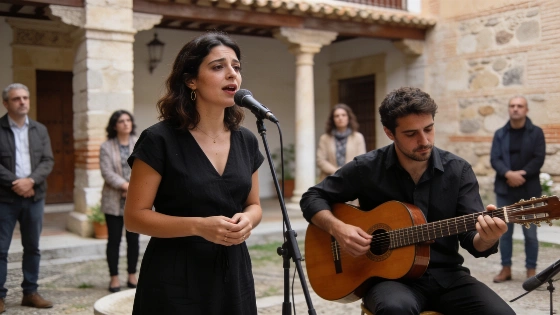
Each day moves to a different part of the city. Thursday’s water act opens with laments and performances at venues including the Casa de los Tiros. Rocío Márquez and Adriano Galante are among the performers. José Bonaparte and Rocío Morales are also on the bill. Rubén Campos performs, as does Soleá Morente. Zeke Olmo joins the programme. The opening features Ay, Rocío Márquez’s work built around Lorca’s “ay” and the flamenco quejío. Soleá Morente appears in La Llorera.
Friday turns to earth. The Campaneros de Granada will restore the manual toll of the Torre de la Vela. Guille Galván, guitarist and songwriter with Vetusta Morla, composed a piece for the day. It brings him together with cantaora Ángeles Toledano. Drummer Eric Jiménez and singer Miguel García Cantera, known as Dandy Piranha, also perform. The day’s programme culminates with 200 voices singing together in Plaza de las Pasiegas.
Saturday’s fire act centres on a farewell ceremony. One of three songs will sound at La Madraza; another is set for the Corral del Carbón. The third will be performed at the Cathedral. The programme pairs a litany with the Cant de la Sibil·la and Wolfgang Amadeus Mozart’s Requiem in D minor, K. 626. It also includes a concealed reading of Llanto por Ignacio Sánchez Mejías. The Cathedral concert is scheduled for 7:30 p.m. on 17 October. The Orquesta Ciudad de Granada will perform with its choir. Organist Concepción Fernández Vivas will join them, with Lucas Macías conducting. The vocal soloists are Pilar Alva-Martín and Marie-Claude Chappuis. Emiliano González and Reinhard Hagen complete the soloist lineup. Admission is free with an invitation.
On Sunday, the air act begins with readings by Sara Torres and María Eloy-García at the Carmen de los Mártires. Rosa Berbel will also read there before the programme moves to the Alhambra. Bells will ring across Granada, followed by a sound tribute to Lorca from the Alhambra. The Torre de la Vela will sound for the final time as colour and smoke fill the sky.