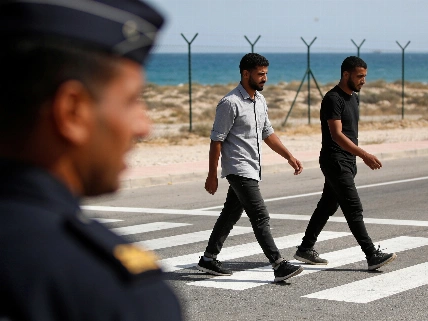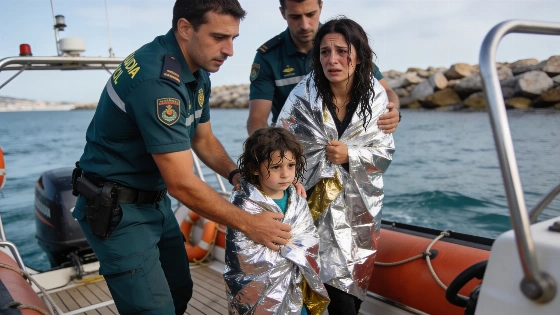
Ceuta’s maritime rescue teams faced unprecedented pressure as hundreds of migrants, including families with children, attempted to cross the border by sea. The scale of the crisis forced urgent action and exposed the limits of current resources.
Ceuta’s maritime border was the scene of intense rescue operations last Thursday as Guardia Civil teams worked under extreme pressure to save migrants attempting to reach Spanish territory by sea. Among the most critical incidents was the rescue of a three-year-old boy, his pregnant mother, and his father, who had spent hours in the water before being pulled to safety. The family, originally from Larache, Morocco, was found clinging to a float, with the child suffering from hypothermia and his mother visibly distressed. The rapid intervention of the rescue teams, who managed to bring them ashore within minutes, was described by officers as both a relief and a rare moment of joy amid a broader humanitarian crisis.
According to the officers involved, the scale of the crossings quickly overwhelmed available resources. Boats were filled beyond capacity, and teams had to coordinate closely to prioritize the most vulnerable cases. The head of the Maritime Service, Captain Roberto García, reported that last year alone, his unit rescued 10,000 people from the water. On the day of the mass crossing, more than 72,000 people attempted to enter Ceuta from Morocco, with divers from the Special Group for Underwater Activities (GEAS) deployed to reach inaccessible areas and recover bodies. In 2025, GEAS teams retrieved 46 deceased migrants from the sea, highlighting the deadly risks involved in these crossings.
Rescue operations were further complicated by the chaotic conditions at the Tarajal breakwater, where hundreds of migrants tried to climb over rocks or struggled in the water. Officers described forming human chains to prevent people from drowning, while Red Cross volunteers and other emergency personnel assisted from the shore. In one widely circulated image, a GEAS diver is seen saving a baby from a sea crowded with desperate swimmers. The situation escalated to the point where boats could no longer be used safely, forcing rescuers to enter the water directly to assist families and children.
The surge in sea crossings has been linked to a Supreme Court ruling that prohibited immediate returns to Morocco for those who swim across, due to the absence of physical border barriers. This legal change, combined with poor weather conditions that limit Moroccan patrols, has led to a sharp increase in attempts. In response, the Spanish government installed a 500-meter floating barrier near the breakwater to enable legal pushbacks. The majority of those attempting the crossing in recent weeks have come from northern Morocco, with entire families now risking the journey. Officers recounted dramatic rescues, including that of a young man missing an arm, who was applauded by fellow migrants after reaching safety.
Medical emergencies have become common, with many migrants suffering from hypothermia, exhaustion, or shock. In one case, a Maritime Service officer performed CPR on a man with no pulse, saving his life according to medical staff. The relentless pace of rescues has left teams physically and emotionally drained, but officers emphasize that their duty is to provide assistance regardless of the risks. The ongoing crisis has also prompted policy changes, as detailed in a recent report on the government’s deployment of a floating barrier and new pushback measures at Ceuta, which can be found in this analysis of Spain’s border response.
Ceuta’s unique position as a Spanish enclave bordering Morocco has made it a focal point for irregular migration in recent years. The city’s rescue teams, supported by reinforcements, continue to face high-risk situations as migrants seek new routes into Europe. The humanitarian and logistical challenges remain acute, with authorities balancing legal obligations, operational safety, and the urgent need to save lives at sea.