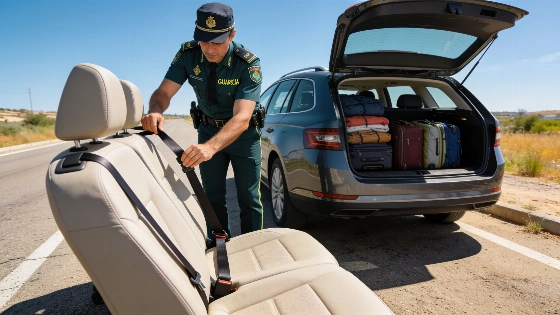
The Guardia Civil has posted a video on social media urging drivers to keep the rear seat belts buckled, even when the seats are empty. Delivered by a uniformed officer, the advice addresses a risk many drivers overlook: unsecured luggage can become a serious threat in an accident.
In a collision or abrupt stop, loose items such as bags and suitcases can slide or tip over, then fly into the passenger area. Mercedes-Benz’s official loading guidance warns that unsecured objects can hit vehicle occupants, even when they are wearing seat belts. The risk extends beyond collisions: sudden braking or a sharp change in direction can also send loose cargo forward.
How the Trick Works
Fastening unused rear seat belts is presented as an added precaution that may help restrain the seatbacks in some vehicle configurations. Its effectiveness depends on the vehicle’s design, belt geometry and seatback construction, as well as the load’s position and mass. The belts are not a substitute for a cargo net or tie-down straps, or for a luggage partition. International vehicle regulations address seat belts and related systems separately from seat strength and anchorages, reflecting their distinct occupant-protection functions.
The Guardia Civil’s message is especially relevant during holiday periods, when families often travel with fully loaded cars. Mercedes-Benz guidance recommends placing heavy items low and close to the seatbacks, keeping cargo below their top edge and securing it with the vehicle’s tie-down points. Where fitted, a partitioning net should separate the load compartment from occupants. Drivers should also observe the vehicle’s permitted gross mass and axle loads. Cargo should be distributed evenly, since loading affects handling.
Everyday Objects, Hidden Dangers
Even small items, such as a water bottle or a book, can become hazardous in a sudden stop. A handbag poses the same risk. Their mass does not change, but rapid deceleration can produce large impact forces, turning loose objects into projectiles that can injure occupants.
To reduce the risk, the Guardia Civil recommends keeping loose objects off rear shelves and seats. Items should be secured in the load compartment, with the heaviest pieces placed at the bottom and kept close to the seatbacks. Mercedes-Benz also advises using tie-down eyes to secure loads and distributing the tension evenly.
Changing Habits, Saving Lives
The campaign encourages drivers to adopt small habits that can improve road safety. Buckling unused rear seat belts takes only seconds, but it should be treated as a supplementary precaution, not a guaranteed way to contain cargo. Properly securing luggage remains the basic measure.
The advice reflects the broader challenge of managing cargo inside vehicles, particularly on long trips. Manufacturer guidance warns that load distribution affects a vehicle’s handling. It also advises against abrupt maneuvers, including hard braking or rapid cornering, when carrying a load.
UN vehicle regulations cover occupant-protection components through separate provisions. Regulation No. 16 addresses safety belts and related systems, while Regulation No. 17 covers seat strength and anchorages. Regulation No. 14 addresses safety-belt anchorages. These rules distinguish occupant restraints from dedicated cargo-retention equipment: a seat belt is not a replacement for a net or tie-down, or for a partition designed to secure luggage.