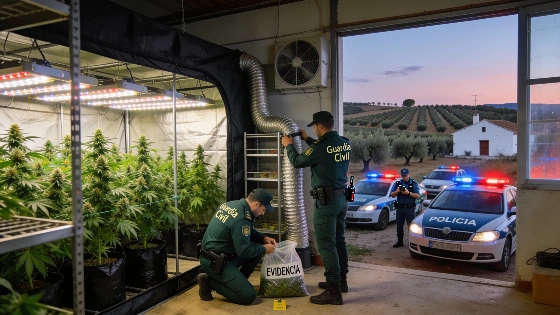
A pig farm in Castellón was used to conceal a cannabis operation. Guardia Civil dismantled a plantation with 300 plants and arrested six people. Two suspects are now in prison. The investigation extended to Tarragona.
A pig farm in the small Castellón village of La Salzadella has been revealed as the unlikely front for a sophisticated cannabis cultivation network operating across Castellón and Tarragona. Guardia Civil officers, acting on suspicions that the rural property was being used for illegal activity, traced the operation to several locations, ultimately dismantling an indoor marijuana plantation with 300 plants in Oropesa del Mar and arresting six individuals.
The investigation, codenamed operación Carxofa, began when agents noticed irregularities at the La Salzadella farm. Although no cannabis plants were found during the search of the farm itself, evidence indicated that the facilities had previously supported large-scale cannabis production. This discovery led authorities to expand their probe, uncovering a broader network that spanned multiple sites in both Castellón and Tarragona provinces.
The breakthrough came when officers identified an active indoor plantation in a residential property in Oropesa del Mar, a coastal town in Castellón. There, they found 300 mature marijuana plants in advanced stages of flowering. The property was equipped with a complex infrastructure designed for intensive cultivation, including illegal lighting, ventilation, climate control, and environmental monitoring systems. Investigators also located a storage area used for growing and processing the drug.
Further searches were conducted at a third location in Godall, Tarragona, resulting in two of the six arrests. The detainees—five men and one woman—face charges of crimes against public health, electricity fraud, money laundering, and membership in a criminal group. Following police procedures, all suspects were brought before the judicial authorities, with two ordered into custody.
The operation was carried out by the Unidad Orgánica de Policía Judicial (UOPJ) of the Guardia Civil in Castellón, with support from the Unidad de Seguridad Ciudadana de la Comandancia (USECIC) and local patrols from Oropesa del Mar. The case is being coordinated by the Special Anti-Drug Prosecutor's Office in Castellón de la Plana, and the suspects were presented before the Tribunal de Instancia in the city.
This case highlights the evolving tactics of criminal groups in Spain, who increasingly use rural or agricultural properties to mask illegal activities. The use of advanced technology and infrastructure for indoor cultivation has made detection more challenging for authorities. Similar incidents have been reported in other regions, reflecting a broader trend in organized crime adapting to law enforcement efforts. In Catalonia, for example, police have faced a rise in violent incidents linked to drug operations, as seen in the recent fatal shooting of a teenager in Barcelona’s La Pegaso district.
Spain remains one of the main entry points for cannabis into Europe, with law enforcement agencies regularly dismantling plantations and trafficking networks. The country’s climate and rural landscape, combined with its proximity to North Africa, make it a strategic location for such operations. Authorities continue to adapt their strategies, focusing on intelligence-led investigations and inter-agency cooperation to combat the ongoing challenge posed by organized drug crime.