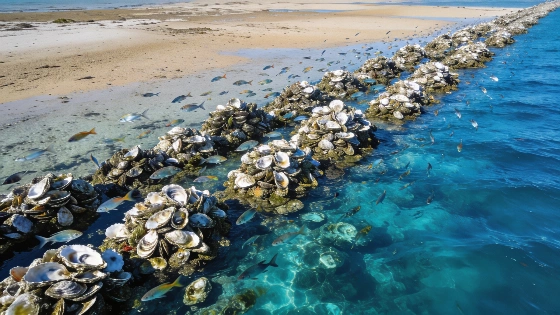
Over 500,000 tons of recycled oyster and clam shells, once destined for landfills, have been used to rebuild lost reefs along Florida’s Gulf Coast. The project has restored vital habitats, boosted oyster populations, and improved water quality, transforming what was once considered waste into a foundation for marine life.
Between 2007 and 2024, Florida quietly launched one of the largest coastal restoration efforts in the United States, repurposing more than 500,000 tons of discarded oyster and clam shells to rebuild reefs that had all but vanished from the Gulf of Mexico. Sourced from seafood restaurants and processing plants, these shells were diverted from landfills and instead deposited along stretches of degraded coastline, where natural reefs had been lost to overharvesting, pollution, and development.
What began as a practical solution to a mounting waste problem has since become a model for ecological recovery. The recycled shells provided the hard, stable surfaces that young oysters need to attach and grow—a critical factor, as the original reefs had been replaced by shifting sands and soft sediments, making it nearly impossible for new oyster populations to establish themselves.
Restoring Lost Foundations
Natural oyster reefs once protected Florida’s shores, filtering water and supporting a web of marine life. Their disappearance left the seafloor unstable and lifeless in many areas. By layering recycled shells on the seabed, the project recreated the essential hard substrate that oyster larvae require. Over time, these new surfaces became the backbone for emerging reefs, attracting not only oysters but also fish, crabs, and countless other species.
Unlike some restoration methods, this approach did not require harvesting new shells from the ocean. Instead, it relied entirely on shells already used in the food industry, collected and transported to the most damaged coastal zones. This closed-loop system minimized environmental impact while maximizing ecological benefit.
How Shells Sparked Recovery
The transformation beneath the water was gradual but profound. As soon as the shells were submerged, bacteria colonized their surfaces, forming a thin biofilm. This biological layer created the right conditions for other organisms to settle and thrive. As the shells slowly broke down, they released calcium, subtly altering the local chemistry and further supporting marine life.
Years passed before the results became visible from above, but underwater, the process was already underway. The combination of a hard foundation and changing microenvironments allowed a diverse community of plants and animals to return. The new reefs not only anchored oyster populations but also provided shelter and food for a wide range of species.
From Skepticism to Success
Initially, the project faced criticism and skepticism. Some observers questioned whether dumping large quantities of shells into the sea was simply another form of pollution, and the lack of immediate results fueled doubts—even among researchers. However, as time went on, evidence mounted that the recycled shells were doing exactly what was hoped: supporting the growth of new oyster reefs and restoring lost ecological functions.
Today, the revived reefs are filtering seawater, improving clarity, and reducing harmful algal blooms. The oysters themselves act as natural water purifiers, and their resurgence has had a ripple effect, benefiting seagrasses, fish, and other marine life. According to data reported by Talent24h, the project has become a case study in how sustained, targeted intervention can repair damaged ecosystems using resources that would otherwise go to waste.
Cleaner Water, More Life
The impact of the restored reefs extends beyond oysters. As the reefs filter water and stabilize the seabed, they create conditions for a broader range of marine plants and animals to flourish. Researchers have linked the cleaner water to a decline in harmful algal blooms, while the increased habitat complexity supports greater biodiversity along the coast.
Florida’s shell recycling initiative demonstrates that even materials once dismissed as waste can become powerful tools for environmental recovery. By turning discarded shells into the foundation for new life, the project has not only revived lost habitats but also offered a blueprint for sustainable restoration efforts elsewhere.