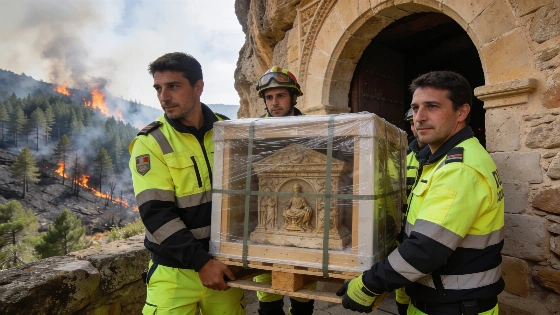
A major wildfire in Huesca has forced the removal of royal remains and heritage items from San Juan de la Peña. Nearly 900 residents have been evacuated as flames approach key cultural sites. Authorities intensify firefighting efforts.
Emergency crews in Aragón have removed royal remains and valuable artifacts from the Monasterio Viejo de San Juan de la Peña as a fast-moving wildfire continues to threaten this historic site in Huesca. The operation, carried out by government technicians and the Unidad Militar de Emergencias (UME), included the extraction of bones from the Pabellón Real and items such as the attire of the X Conde de Aranda. These measures come as the fire, which broke out on Monday in Las Peñas de Riglos, advances toward both the old and new monasteries, putting centuries-old heritage at risk.
So far, the wildfire has scorched around 8,000 hectares and forced the evacuation of nearly 900 people from 12 villages, including Villalangua, Salinas de Jaca, Ena, Centenero, Arbués, Alastuey, Bailo, Larués, Botaya, Santa Cruz de la Serós, Binacua, and Osia, as well as the Pirineos campsite near the N-240 road. The Ministry of Defence has deployed two UME sections overnight, working alongside regional brigades, MITECO, and local fire services. The situation remains critical, with authorities shifting their strategy to protect the monasteries and the municipality of Santa Cilia de Jaca, which, along with Puente la Reina, is now under confinement.
According to Aragón officials, the extracted relics and heritage pieces have been transferred to the Museo de Huesca as a precaution. The intervention required a second attempt after initial efforts were halted due to the proximity of the flames. The operation also included the removal of paintings and other patrimonial objects, ensuring their safety as the fire reached the protected natural area surrounding the monasteries, though it has not yet entered the buildings themselves.
The Monasterio Nuevo, located in the Pradera de San Indalecio, was originally built after a 17th-century fire destroyed the original monastery beneath the rock. Both sites are now under direct threat, prompting a reinforced response from the UME, which has brought in additional battalions from Torrejón de Ardoz (Madrid) and Bétera (Valencia), joining the Zaragoza-based BIEM IV unit. This expanded deployment reflects the growing scale of the emergency, with the fire perimeter now estimated at 58 kilometers.
Elsewhere in Spain, wildfires continue to challenge emergency services. In Huelva, the Niebla fire has already burned more than 31,000 hectares, with 31 aircraft and 650 ground personnel engaged in containment efforts. Progress in the northern sector has allowed some evacuees to return home, but shifting winds and low humidity remain a concern. The scale of these incidents recalls recent events in Segovia, where residents were only recently allowed to return after wildfire risks subsided.
San Juan de la Peña is one of Aragón’s most significant historical and cultural landmarks, housing royal tombs and centuries-old artifacts. The current threat underscores the vulnerability of Spain’s heritage sites to extreme weather and wildfire events. As firefighting operations continue, the focus remains on safeguarding both the local population and irreplaceable cultural treasures.
Spain has seen a rise in large-scale wildfires in recent years, often exacerbated by prolonged drought and high temperatures. The protection of cultural heritage during such emergencies has become a growing priority for regional and national authorities. The rapid response in Huesca highlights the logistical and strategic challenges involved in preserving history under threat from natural disasters.