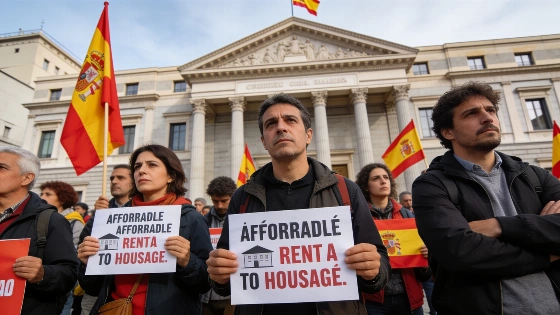
CCOO and UGT are calling for demonstrations after Congress rejected two housing decrees. The unions say families facing eviction and unaffordable rents have been left without urgent relief.
The first decree lost the vote 178 to 172. The second failed 184 to 166. PP, Junts, Vox and UPyN voted against validating the measures, leaving CCOO and UGT calling workers into the streets this weekend.
The unions say hundreds of thousands of people now face longer housing insecurity and costs they cannot keep carrying. Congress rejected both government decrees aimed at Spain's housing emergency.
The numbers were close.
The first housing decree lost the vote 178–172, and the second 184–166, leaving neither measure with the parliamentary confirmation required to remain in force.
The decision followed a wave of public action over soaring purchase prices and rents. In Madrid, the eviction of Mari Carmen became a trigger for demonstrations in streets and squares across the country. Many citizens have refused to accept housing insecurity as normal.
CCOO and UGT do not claim that the decrees would have solved the crisis on their own. They say the measures were still necessary for people at immediate risk of losing their homes or unable to meet monthly housing costs. The unions described them as urgent but insufficient responses to an emergency affecting tenants and families facing eviction.
The first decree included protection for vulnerable households facing eviction. It also contained restrictions aimed at speculative purchases and measures to limit certain rent increases. The second would have introduced automatic rental contract extensions. That would have given tenants more time to seek a longer-term solution.
The political fight has now moved into the streets. The government adopted the measures as emergency provisions intended to take effect immediately. Their continuation still required validation by Congress.
Congress rejected them.
The defeat weakens the government's attempt to act quickly on the housing crisis. It also adds pressure on Prime Minister Pedro Sánchez.
Reuters reported that objections from Junts on the eve of the vote had already weakened the decrees’ prospects. On 2 October, activists and demonstrators also gathered around Congress in Madrid, demanding tougher action on the housing crisis.
The unions accuse the parliamentary right and far right of putting housing speculators' interests above the right to a decent home. Their criticism is directed at the parties that blocked the measures. Those parties now face questions from families threatened with eviction and workers whose salaries cannot cover rent.
PNV and Coalición Canaria also opposed the decree in the second vote, according to reports on the parliamentary tally.
Housing has become Spain's main source of impoverishment and inequality, according to the unions' assessment. A growing share of employment income goes to the property market. Young people are struggling to leave the family home, while the right recognised in Article 47 of the Constitution is treated as an object of speculation.
The pressure reaches beyond tenants.
CCOO and UGT link the housing crisis to wages and to how economic growth is shared. They say company profits have not been passed on enough through salaries. Rising prices have also cut the purchasing power of millions of workers.
Even negotiated increases in collective agreements or a higher minimum wage can disappear month after month into rent or mortgage payments.
That is why the unions want action on two fronts. They are calling for stronger public intervention to curb speculation, expand affordable public housing and protect tenants. They also want substantial wage improvements through collective bargaining.
Employment must provide more than income on paper. It must help people pay for a roof.
CCOO and UGT called for parliamentary validation of both decrees the day before the vote. They said social mobilisation had already helped put housing measures on the political agenda.
Now they say the defeat makes demonstrations necessary. The immediate protections backed by the unions will not remain in place.
The vote has deepened the political blockage around housing. BBC reported that the government's loss has increased internal pressure on Sánchez, including renewed discussion of possible early elections.
The dispute is no longer limited to rental rules or eviction safeguards. It now connects parliamentary instability with a wider clash involving the government, opposition parties, trade unions and housing activists.
The weekend mobilisation is meant to turn public anger into pressure for new measures. CCOO and UGT say a decent home cannot depend only on market prices or on whether a household can absorb another rent increase.
They want housing policy tied to stronger wages and a larger supply of affordable public housing.