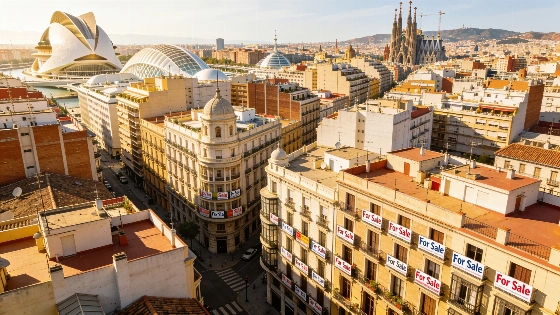
A surge in available homes is signaling a slowdown in Spain’s largest cities. With more properties on the market and early signs of price negotiations, buyers may find new leverage—especially outside city centers.
Madrid, Valencia, Barcelona, Seville, and Málaga are seeing a marked increase in homes for sale, a shift that real estate expert Sergio Gutiérrez believes could reshape Spain’s property market. According to Gutiérrez, the recent uptick in housing stock is a clear sign that the market is entering a new phase—one where buyers may finally gain the upper hand after years of soaring prices and fierce competition.
Gutiérrez, who shared his analysis on TikTok, points to fresh data showing a slowdown in transactions. The National Statistics Institute (INE) reports that home sales in April dropped by 1.8% compared to the previous year, totaling 53,241 deals. This cooling trend is most visible in Spain’s largest urban centers, where the number of properties listed for sale is climbing at a pace not seen in recent years.
Stock Growth Signals Shift
Figures from Daniel del Pozo, managing director at idealista/data, highlight the scale of the change: Madrid’s housing stock has grown by 17%, Valencia by 13%, Barcelona by 6%, Seville by 5%, and Málaga by 3%. Gutiérrez interprets this as a sign that buyers are stepping back, unwilling to meet the high prices that have defined the market. “We’re approaching a turning point because people aren’t willing to pay just anything anymore,” he notes.
As supply rises and sales slow, sellers are losing the leverage to hold firm on price. While this doesn’t mean an immediate drop across the board, it does suggest that price growth will moderate—especially in areas where affordability has become a major barrier.
Prices Remain High, but Discounts Emerge
Despite the shift in supply and demand, prices remain at record levels. Idealista reports that the average price for a resale home in Spain reached €2,795 per square meter in May, up 16.9% year-on-year. Fotocasa’s index puts the average at €3,092 per square meter, with a typical 80-square-meter home now costing €247,391.
However, there are early signs of negotiation. Idealista found that 14% of home listings saw price reductions in the first quarter of the year, up from 11% a year earlier. In Barcelona and Teruel, 21% of listings were discounted, while Madrid saw 20% and Málaga, Seville, and Valencia each reached 18%.
Periphery Gains Appeal
Gutiérrez observes that the market is now moving at two speeds. While central neighborhoods in major cities are cooling, demand remains stronger in the suburbs and in some mid-sized cities. Buyers are increasingly looking for areas where prices still align with their budgets, making the outskirts a more attractive option—provided the price is right.
The coming months will reveal whether the growing stock leads to broader price cuts or if sellers continue to hold out. For now, the data points to a less frenetic market, with high prices persisting but more room for negotiation and significant differences between neighborhoods.
For those considering a purchase, the current environment may offer new opportunities—especially for buyers willing to look beyond the city center. As the market adjusts, keeping an eye on local trends and price movements will be key to making informed decisions.