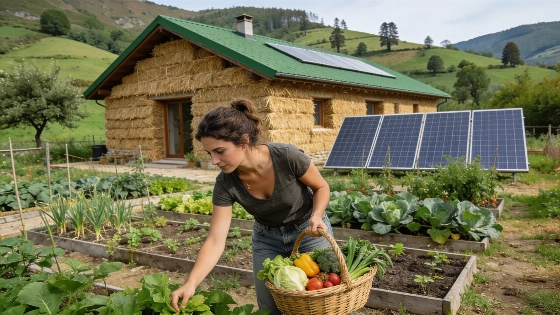
In the Karrantza valley, Erika Yurre’s family left city life behind to build a straw-bale house powered by solar panels and surrounded by their own vegetable garden. Their approach has cut expenses and changed their daily routine, showing what’s possible with local materials and careful planning.
When Erika Yurre and her family moved from the city to the rural valley of Karrantza in Bizkaia, they set out to build a home that would free them from the cycle of rising bills and supermarket dependency. Their solution: a house constructed from straw bales, local wood, and natural finishes, designed to minimize both environmental impact and monthly expenses.
The family’s home stands out for its thick straw-bale walls, which were built using rye straw left over from local harvests. This method, rarely seen in conventional Spanish construction, provides exceptional insulation and reduces the need for artificial heating and cooling. The project was a community effort, with more than 50 volunteers—including architects, engineers, and biologists—joining the build, as documented by Gazteaukera, a Basque government portal.
Natural Materials and Community Effort
Instead of bricks or concrete, the Yurre family relied on straw bales and timber sourced from the surrounding area. The walls were finished with a blend of lime and sand, creating a breathable, durable surface. Even their family bakery, Ama Orea, was built using the same principles, with a wood-fired oven fueled by pruned branches, deadwood, and recycled material.
While alternative materials offer clear benefits, the family still had to navigate local building codes and technical standards. Each rural construction project in Spain depends on land classification, municipal permits, and the specifics of the design, making the process complex but not impossible.
Passive Heating and Solar Power
The house’s roof is covered with a layer of earth and grass, forming a living green roof that insulates against both summer heat and winter cold. Large south-facing windows capture sunlight during the colder months, warming the interior without constant reliance on mechanical systems. When temperatures drop, a wood-burning stove doubles as both a heater and a cooker.
Electricity comes from a standalone solar photovoltaic system, which powers both the home and the bakery. While the family no longer receives a monthly electricity bill, the initial investment in solar panels and batteries was significant. Maintenance and occasional component replacements are still necessary, but the system has allowed them to operate independently from the grid.
Food from the Land, Not the Supermarket
Much of the family’s food comes from their own vegetable garden, carefully planned to supply onions, leeks, and other staples throughout the year. Fruit trees supplement their harvest, and what they can’t grow themselves, they buy directly from local farmers and producers in Karrantza. Meat, honey, and dairy are sourced nearby, while dry goods like legumes are purchased in bulk to last several months.
This approach means supermarket trips are rare—about once every three months, mainly for household items and products unavailable locally. However, complete self-sufficiency remains elusive. For example, the bakery’s demand for organic wheat flour exceeds what is produced in the Basque Country, so some ingredients must be brought in from other regions.
Reducing, Not Eliminating, Dependency
The Yurre family’s lifestyle blends bioclimatic architecture, renewable energy, wood heating, home-grown food, and close ties with local producers. Their experience shows that while it’s possible to dramatically reduce reliance on conventional utilities and supermarkets, some level of external dependency remains—especially for certain foods and technical maintenance.
Ama Orea, their bakery, now supplies sourdough bread and pastries to customers in Karrantza, Bilbao, and other towns in Bizkaia. The project stands as a practical example of how rural living, when combined with thoughtful design and community support, can offer a real alternative to urban life and rising costs.
As more people in Spain consider ways to cut expenses and live more sustainably, stories like Erika Yurre’s highlight both the opportunities and the challenges of building a self-sufficient home in the countryside.